Skip to content

Cracks visible in Iran’s leadership as new strikes light up Tehran

Ziggy Ojiegbe
Palpable cracks are emerging within Iran’s leadership at a time when the country is facing intensifying attacks from the United States and Israel, raising doubts about who is directing Tehran’s war strategy as the conflict enters its second week.

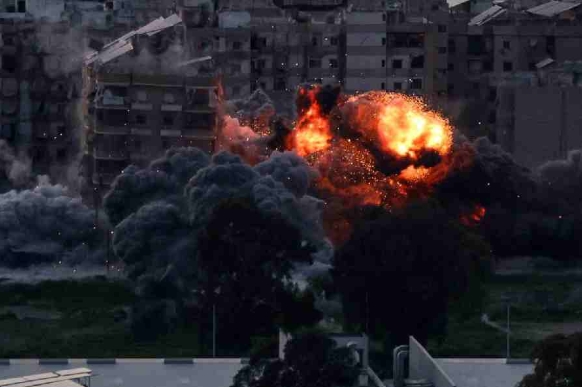
The divisions became visible over the weekend as explosions once again lit up the skies above Tehran following fresh Israeli strikes. Israeli Prime Minister Benjamin Netanyahu warned that the next phase of the war would bring “many surprises.”
At the same time, conflicting messages from Iran’s leaders highlighted possible coordination gaps within the country’s command structure, particularly between political authorities and the powerful Islamic Revolutionary Guard Corps (IRGC).
An Iranian oil storage facility supplying Tehran and nearby northern provinces was hit late Saturday in an attack blamed on Israel and the United States. The strike appeared to mark the first time a non-military site had been targeted since the war began.
Earlier in the day, Iran’s president, Masoud Pezeshkian, publicly apologized to neighboring countries for Iranian attacks on their territories and called for restraint.
“From now on, they should not attack neighboring countries or fire missiles at them unless we are attacked,” Pezeshkian said in a hastily recorded message, suggesting the crisis should be resolved through diplomacy.
But other senior officials quickly signaled that Iran’s war strategy would remain aggressive.
Judiciary chief Gholam Hossein Mohseni‑Ejei, another member of the leadership council overseeing Iran since the killing of Supreme Leader Ali Khamenei in the war’s opening airstrikes, warned that attacks on regional targets used by U.S. forces would continue.
“The geography of some countries in the region … is in the hands of the enemy,” he wrote on social media, adding that Iran would maintain “intense attacks” against such locations.
Iran’s parliament speaker, Mohammad Bagher Ghalibaf, echoed the hard-line position, saying countries hosting U.S. bases would not enjoy peace while those forces remain in the region.
The mixed signals reflect deeper divisions within Iran’s ruling elite that had largely remained hidden during Khamenei’s decades-long rule but have begun surfacing since his death.
Meanwhile, U.S. President Donald Trump warned that Iran could soon be “hit very hard,” suggesting more targets and groups could be struck in the escalating campaign.
Across Tehran, residents reported heavy bombardment throughout the day.
“Tehran is under severe bombardment,” said a university student in western Tehran who spoke anonymously for security reasons. “Even people far from military sites are living in fear.”
The United States and Israel say their campaign is aimed at crippling Iran’s military capabilities, leadership and nuclear program.
The conflict has also spread across the region. Incoming Iranian missiles again forced people across Israel into bomb shelters, while a missile landed in the U.S. embassy compound in Baghdad’s fortified Green Zone, according to Iraqi security officials.
Iraq’s caretaker prime minister, Mohammed Shia al‑Sudani, condemned the attack as a “terrorist act” carried out by rogue groups.
Gulf states have also been caught in the widening confrontation. Interceptions of Iranian missiles and drones have been reported in Bahrain, Saudi Arabia and the United Arab Emirates, where authorities said debris from an aerial interception killed a foreign driver on Saturday.
With the war expanding and divisions emerging at the top of Iran’s political structure, analysts warn that the conflict could become even more unpredictable in the days ahead.