Skip to content

Food prices drive inflationary trends for 3rd straight month

- Annual rate climbs to 15.93%
Frank Okon
Nigeria’s annual inflation rate rose for the third consecutive month in May 2026, driven largely by persistent increases in food prices despite a moderation in the pace of monthly price growth.

The latest Consumer Price Index (CPI) report released by the National Bureau of Statistics (NBS) showed that headline inflation increased to 15.93 per cent in May from 15.69 per cent in April, extending the upward trend that began in March after inflation eased to 15.06 per cent in February.
The report showed that the Consumer Price Index rose to 140.7 points in May from 138.3 points recorded in April, reflecting a 2.4-point increase in the overall price level.
Although the annual inflation rate continued to climb, the month-on-month rate slowed, indicating that prices were still increasing but at a slower pace than in the previous month.
According to the NBS, headline inflation on a month-on-month basis stood at 1.75 per cent in May, down from 2.13 per cent in April.
“In May 2026, the Headline inflation rate on a month-on-month basis was 1.75 per cent, which was 0.39 per cent lower than the rate recorded in April 2026 (2.13 per cent). This means that in May 2026, the rate of increase in the average price level was lower than the rate of increase in the average price level in April 2026,” the bureau stated.
Despite the moderation in monthly price increases, annual inflation maintained its upward trajectory, rising from 15.38 per cent in March to 15.69 per cent in April before reaching 15.93 per cent in May.
The bureau noted that while the latest figure represented a 0.24 percentage-point increase over April, it remained significantly below the 26.06 per cent recorded in May 2025, underscoring the considerable easing in inflationary pressures compared to a year earlier.
A breakdown of the inflation basket showed that food and non-alcoholic beverages remained the largest contributor to headline inflation, accounting for 6.38 percentage points of the annual inflation rate.
Restaurants and accommodation services contributed 2.06 percentage points, transport accounted for 1.70 percentage points, while housing, water, electricity, gas and other fuels added 1.34 percentage points.
Education services contributed 0.99 percentage points, health 0.97 percentage points, clothing and footwear 0.80 percentage points, while information and communication as well as personal care and miscellaneous goods and services each contributed 0.52 percentage points.
The report also showed that average inflation for the twelve months ending May 2026 stood at 18.36 per cent, compared with 30.57 per cent during the corresponding period in 2025.
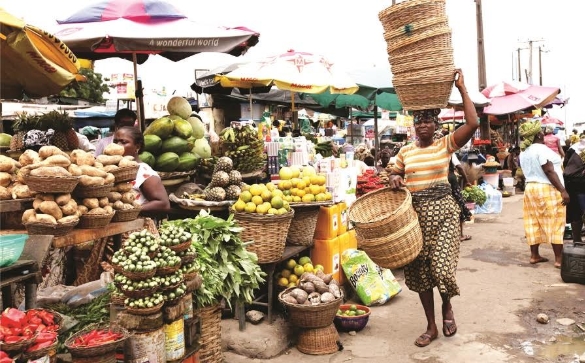
Food prices remained the dominant source of inflationary pressure.
According to the NBS, food inflation rose to 16.96 per cent year-on-year in May, compared with 24.55 per cent in May 2025. On a month-on-month basis, however, food inflation slowed to 2.98 per cent from 3.63 per cent recorded in April.
The increase was attributed to rising prices of staple foods including onions, maize grains, melon, water yam, cassava flour, crayfish, fresh pepper, tomatoes, wheat grain, cassava tubers, yam tubers, sweet potatoes, ginger, plantain and cowpea.
“The average annual rate of Food inflation for the twelve months ending May 2026 over the previous twelve-month average was 16.99 per cent, which was 16.22 percentage points lower compared with the average annual rate of change recorded in May 2025 (33.21 per cent),” the report stated.
Beyond food, the report indicated that underlying inflationary pressures remained resilient across the broader economy.
Core inflation, which excludes volatile agricultural produce and energy prices, stood at 16.82 per cent year-on-year in May, down from 24.92 per cent recorded in the same month last year.
However, on a month-on-month basis, core inflation accelerated sharply to 1.94 per cent from 1.03 per cent in April, suggesting that price pressures outside food and energy strengthened during the month.
Urban inflation was recorded at 16.07 per cent year-on-year, while monthly urban inflation increased to 1.99 per cent from 1.86 per cent in April. The twelve-month average urban inflation rate eased to 18.27 per cent, significantly below the 32.55 per cent recorded a year earlier.
In rural areas, annual inflation stood at 15.60 per cent, while monthly rural inflation slowed markedly to 1.17 per cent from 2.80 per cent in April. The twelve-month average rural inflation rate also declined to 18.19 per cent, compared with 28.36 per cent in May 2025.
The NBS further reported that services inflation remained elevated at 17.92 per cent year-on-year and 2.84 per cent month-on-month.
Imported food inflation stood at 14.60 per cent annually and 2.28 per cent monthly, while goods inflation was recorded at 6.62 per cent year-on-year and 0.73 per cent month-on-month. Energy inflation stood at 5.73 per cent year-on-year and 0.72 per cent month-on-month.
State-by-state data revealed significant disparities in inflation levels across the country.
Yobe recorded the highest annual headline inflation rate at 24.94 per cent, followed by Anambra (23.29 per cent) and Sokoto (22.60 per cent).
At the other end of the spectrum, Niger State recorded the lowest annual inflation rate at 3.07 per cent, followed by Plateau (7.10 per cent) and Edo (7.73 per cent).
On a monthly basis, Benue recorded the sharpest increase in headline inflation at 8.23 per cent, followed by Bayelsa (7.62 per cent) and Borno (7.29 per cent).
Conversely, Niger State recorded a 4.55 per cent decline in monthly inflation, while Zamfara and Taraba posted declines of 3.36 per cent and 2.67 per cent, respectively.
Food inflation also varied widely across states.
Adamawa recorded the highest annual food inflation rate at 29.62 per cent, followed by Kwara (28.47 per cent) and Rivers (28.40 per cent).
In contrast, Borno recorded food deflation of 6.53 per cent, while Taraba and Bayelsa posted the slowest annual increases at 1.13 per cent and 5.99 per cent, respectively.
On a month-on-month basis, Bauchi recorded the highest food inflation at 7.73 per cent, followed by Ogun (6.86 per cent) and Jigawa (6.69 per cent).
Meanwhile, Niger, Katsina and Gombe recorded month-on-month food price declines of 3.54 per cent, 3.48 per cent and 2.22 per cent, respectively.
The latest NBS figures indicate that while inflation remains substantially below the levels recorded a year ago, consumer prices continue to rise steadily. The third consecutive monthly increase in annual headline inflation underscores the continued pressure on household purchasing power, with food costs, services and core inflation remaining the principal drivers amid persistent insecurity and global economic uncertainties.