Skip to content

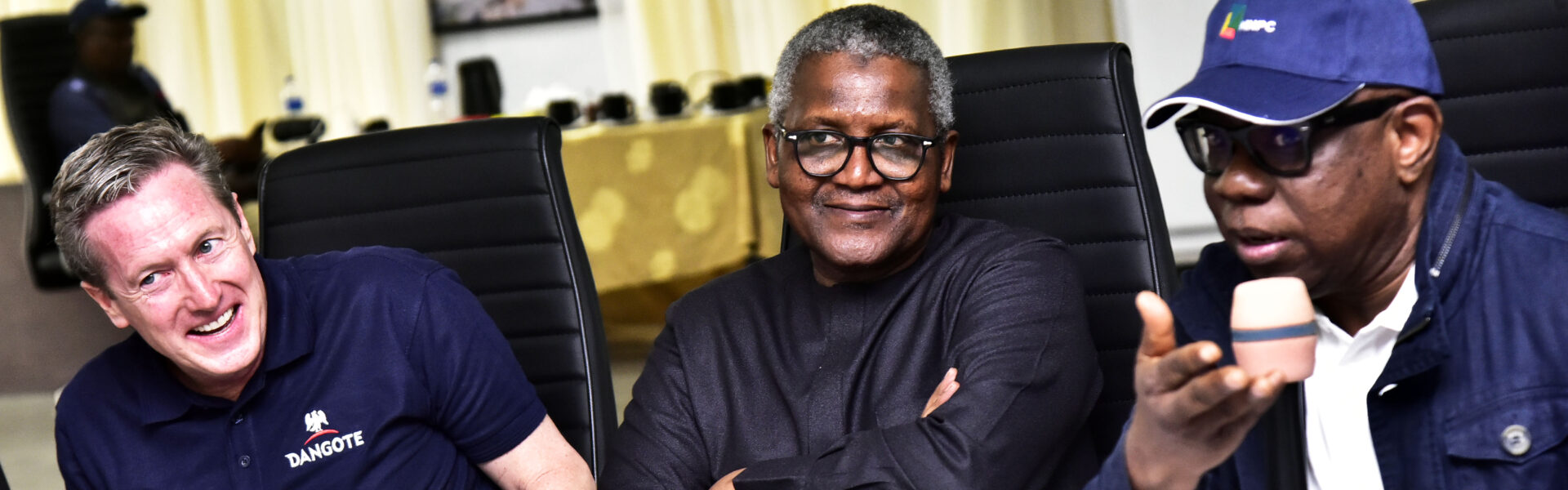
NNPC, Dangote resolve to collaborate, diversify venture opportunities

Two of Nigeria’s most powerful energy players, the Nigerian National Petroleum Company Limited (NNPC) and Dangote Petroleum Refinery & Petrochemicals, have agreed to rebuild and deepen their collaboration as part of a broader push to diversify downstream operations and expand domestic crude processing.
The goal, they stressed, is to unlock greater economic value from Nigeria’s crude oil by processing more of it locally rather than exporting raw materials.

The renewed commitment was announced in Lagos after NNPC Group Chief Executive Officer, Engr. Bashir Bayo Ojulari, visited facilities within the Dangote industrial complex, including Dangote Fertilizers Limited.
The note of cooperation is a deviation from the past acrimonious relationship that evolved between the two companies after state supply monopoly in the domestic fuel market was dismantled alongside liberalization of the domestic market and at a time the Dangote refinery came online as formidable supply force.
Thus, the visit strikes an important chord in the nation’s domestic fuel market where the two companies currently lead feuding supply factions that are at price war. It also indicates reestablishment of closer relationship at the board of Dangote Refinery where NNPC Limited sits as a shareholder.
Beyond shared interest in Dangote Refinery, Engr Ojulari leads a new management of NNPC Limited which has committed to rehabilitation of the country’s three refineries in Port Harcourt, Warri and Kaduna with combined processing capacity of 445,000 barrels per day.
Whereas the areas of the proposed collaboration have not been defined, there is potential for the two partners to explore value optimization opportunities along the full processing loop.
Ojulari and Aliko Dangote said both organizations would work together to identify and drive new ventures across refining, petrochemicals, fertilizer, gas, and power.
“Individually, both organizations command scale, capital and execution capability,” he said. “Collectively, we have the potential to redefine Nigeria’s energy security, deepen industrialization and create enduring national value.”
He emphasized that collaboration would be driven by discipline and performance.
“Collaboration does not mean mediocrity. It means disciplined alignment around shared value creation,” Ojulari said, adding that the immediate focus would be to define concrete areas of partnership ahead of further executive engagements.
Dangote, President of the Dangote Group, described the partnership as central to the refinery’s founding vision. He noted that NNPC currently holds a 7.25 percent equity stake in the refinery on behalf of Nigerians and said expanding cooperation within the existing complex would unlock stronger long-term value.
“This was our dream before it became a reality,” Dangote said. “The partnership between ourselves and NNPC will not only strengthen Nigeria but can also revolutionize the African market.”
He framed the refinery as more than a fuel-processing facility, calling it an integrated industrial hub with opportunities in petrochemicals and fertilizer production. Dangote highlighted plans for a 400,000 metric tonne Linear Alkyl Benzene facility, a key input in detergent manufacturing, which he said would surpass current African production capacity.
Both leaders agreed that increasing refining and petrochemical capacity would strengthen Nigeria’s foreign exchange earnings and deepen its industrial base. Rather than exporting crude oil and importing finished products, they argued, Nigeria can capture more value by prioritizing domestic processing and expanding into higher-value segments such as fertilizer, base oil, and petrochemicals.
Priority areas of collaboration are expected to be identified within weeks, with structured implementation to follow.