Skip to content


WIEN counts 5-year milestones with awards, lays templates for DEI performance

Sopuruchi Onwuka
The Nigerian energy industry will in the week witness a major spur in the concerted efforts to mobilize extensive capital and variegated capabilities in meeting national economic and social aspirations set for public and private participants in the sector.
Leading gender advocacy group in the industry, the Women in Energy Network (WIEN), insists that the aspiration for greater investments, operational efficiency, accountable governance and enhanced value generation is possible when full capabilities of both male and female players are optimized through equal opportunities.
As part of its strident campaign for diversity, equity and inclusion in the Nigerian energy sector, WIEN will in the week install a mirror for policy drivers and corporate players in the industry to rate their performance in providing equal opportunities for capable and qualified women to make meaningful contributions to the growth of the sector.
The launch of the DEI Benchmarks for the industry, and WIEN DEI Awards for outstanding players and agencies in the industry form the highlights of the group’s Annual General Meeting (AGM) scheduled to hold in Lagos.
The overarching call for equitable opportunity for participation comes at a defining moment in the Nigerian energy industry evolution when conversations around investment, energy security, local content development, technological innovation and the transition to cleaner energy are increasingly shaping its future. And the place of women in the industry’s leadership, workforce and decision-making structures continue to dominate debates.
For an industry that prides itself on driving economic growth, technological advancement and national development, the persistent underrepresentation of women in technical, managerial and executive positions raises serious concerns about the inclusiveness of its growth model.
President of WIEN, Mrs Eyono Fatai-Williams, continuously points at the need for the industry to move beyond general expressions of support for gender equity towards measurable institutional commitments that create opportunities for women to participate meaningfully in the sector.
It is in the foreground of this pressing need that the Women in Energy Network (WIEN) marks five years of advocacy, professional development and enterprise support with its 2026 Gala and Awards, alongside the unveiling of an industry-focused DEI Benchmark.
The DEI Benchmark being instituted by WIEN is developed in partnership with KPMG in a milestone that is significant not merely as an anniversary celebration for a professional network established in 2020, but as an opportunity to confront structural barriers that have historically constrained women’s participation in Nigeria’s energy industry.
Oracle Intelligence reports that WIEN has over the past five years sought to establish a stronger platform for women across the oil, gas and power value chains to connect, develop professional capabilities, build businesses and access opportunities in an industry traditionally dominated by men.
Executive Secretary, Engr Asanimo Omezi, explains that the organisation has through networking, mentorship, leadership development and strategic partnerships, contributed to amplifying women’s voices and strengthening their visibility in sector-wide conversations.
Emergence of WIEN significantly reflects the growing recognition that advancement of women in energy cannot be left entirely to individual determination or isolated corporate initiatives. Thus, WIEN drives strong advocacy for deliberate institutional support, access to opportunities, professional networks and workplace policies that recognise and address the peculiar challenges confronting women in the industry.
According to Mrs Fatai-Williams, the energy business is one of the most technically demanding and capital-intensive sectors of the Nigerian economy.
She points at upstream exploration and production to engineering, refining, gas processing, electricity generation, transmission and distribution; saying that women continue to navigate barriers associated with career progression, financing, leadership opportunities and participation in strategic decision-making.
These challenges, she says, are particularly consequential in an industry under official mandate to increase crude oil production, expand domestic refining capacity, commercialise its vast gas resources, improve electricity supply and attract fresh investments.
Realizing the set goals will require a broader pool of talent, expertise and entrepreneurial capacity, Mrs Fatai-Williams points out, arguing that excluding or inadequately representing women in the process amounts to leaving valuable human capital underutilised at a time when the industry needs every available resource to compete, innovate and grow.
Thus, the introduction of the WIEN Energy Sector DEI Benchmark at the organisation’s five-year anniversary offers a potentially more enduring instrument for translating the principles of gender inclusion into measurable corporate performance.
Until now, conversations about women’s empowerment in the workplace had relied heavily on policy declarations, corporate social responsibility programmes, occasional mentorship initiatives and public statements by business leaders.
While the interventions offered varying degrees of value, they do not necessarily translate into meaningful changes in recruitment patterns, promotion opportunities, executive representation or access to strategic assignments, WIEN has noted.
Without clear indicators and accountability mechanisms, WIEN argues, organisations can continue to celebrate diversity while maintaining workplace structures that limit women’s advancement.
WIEN’s Director of Conferences and Partnerships, Bassey Adie, explains that the framework, which is developed in partnership with KPMG, is designed to provide energy companies and institutions with a structured mechanism for assessing their diversity, equity and inclusion practices, identifying institutional gaps and tracking progress towards more inclusive workplaces.
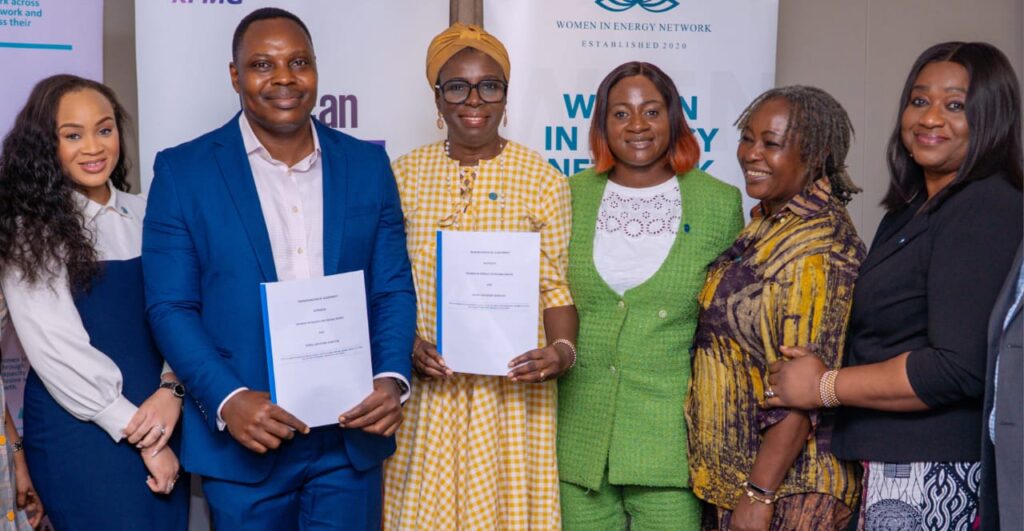
Adie stated that the significance lies in addressing one of the fundamental weaknesses of gender inclusion initiatives in corporate Nigeria, including the absence of consistent, measurable standards against which organisations can evaluate their commitments and demonstrate results.
Mrs Fatai-Williams stated that the WIEN-KPMG benchmark seeks to address the gap by introducing measurable dimensions covering gender representation across organisational levels, inclusive recruitment and hiring practices, leadership and career advancement opportunities, workplace culture, access to professional development, and institutional accountability and reporting.
According to her, these form important areas because gender inclusion must be evaluated beyond the number of women employed by an organisation to also include the positions they occupy, the responsibilities entrusted to them, their access to professional development, their participation in corporate decision-making and the opportunities available for them to advance into senior leadership.
She noted that recruitment of women into entry-level positions means little if workplace structures and promotion practices do not provide equitable opportunities for career progression; saying that an organisation that boasts of substantial female representation in its workforce should have proportionate number of women in executive management, technical leadership or board positions.
WIEN stated that the benchmark offers an opportunity to shift the industry’s focus from numerical representation towards substantive inclusion, where women are not merely present but are adequately positioned to influence corporate policies, shape investment decisions and contribute to the strategic direction of their organisations.
The DEI Benchmark is proposed to apply across the oil, gas and electricity industries as gender-related challenges differ across the various segments of the energy value chain.
According to Mrs Fatai-Williams, the partnership with KPMG brings credibility to the initiative by bringing professional expertise in governance, corporate strategy and institutional assessment into the process.
She pointed out that the collaboration offers an opportunity to develop a framework that reflects international best practices while remaining responsive to the peculiarities of Nigeria’s energy industry.
She however noted that the success of the initiative would ultimately depend on the willingness of energy companies, government agencies and other institutions to adopt the framework, submit to meaningful assessment and translate identified gaps into concrete workplace reforms.
It is for this reason that WIEN anticipates participation of senior executives, policymakers, investors, development partners and other industry stakeholders at the WIEN Gala and Awards to secure institutional buy-in.
Also, the recognition of individuals and organisations championing gender equity is conceived to encourage corporate leadership, promote positive competition and highlight examples of good practice that other institutions can replicate.
Mrs Fatai-Williams told media representatives at a briefing that the drive for gender equity also presents value proposition for businesses in the industry, arguing that gender inclusion remains strategic to achieving positive bottom line.
She made it clear that effective utilisation of available human capital is essential in an industry where Nigeria is seeking to attract billions of dollars in investment, strengthen indigenous capacity and improve operational efficiency.
“A more inclusive workforce can widen the talent pool available to companies, strengthen institutional resilience and bring diverse perspectives to problem-solving, innovation and business strategy.
“For women-owned enterprises, improved access to procurement opportunities, financing and professional networks can also deepen local participation and broaden the economic benefits of energy sector investments,” she pointed out.
Oracle Intelligence recalls that Nigeria is currently pursuing an ambitious domestic energy development agenda; and the petroleum industry needs engineers, geoscientists, project managers, financial specialists, technology professionals and entrepreneurs capable of delivering increasingly complex projects.
Also, the power sector equally requires a broad range of technical and managerial competencies to address its infrastructure and investment challenges.
WIEN argues that there is no justification for allowing outdated workplace practices or institutional biases to restrict access to these opportunities.
With its tight programme for the 2026 AGM Gala and Awards setting new agenda for the industry, WIEN may have expanded its role from amplified advocacy to ensuring that the framework becomes a practical industry instrument with sustained momentum.
In ensuring that the next phase of gender equity advocacy remains effective, WIEN stated that it is working with the KPMG and other partners to engage with corporate boards, chief executives, human resource departments, regulators and professional institutions on periodic assessments, transparent reporting, evidence-based recommendations and a mechanism for recognising organisations that demonstrate measurable improvements.
It is also expected that the benchmark would encourage companies to establish clear targets for women’s participation in technical, managerial and executive positions, while strengthening policies on equal opportunity, workplace safety, professional development, mentorship and career progression.
The initiative would also pay attention to women entrepreneurs and indigenous businesses, particularly those seeking to participate in the industry’s procurement and investment opportunities.
According to Mrs Fatai-Williams, gender inclusion cannot be confined to employment statistics when women-owned businesses remain an important but often underutilised component of the energy value chain.
In all, WIEN’s five-year journey provides a foundation upon which broader ambitions can be pursued. The organisation has helped create visibility for women professionals and strengthened the networks through which they can access opportunities and contribute to industry development. Its collaboration with KPMG now offers an opportunity to elevate that advocacy into a more structured programme of institutional accountability.
Ultimately, the significance of the 2026 Gala and Awards transcends the grandeur of the ceremony to mark a turning point in how Nigeria’s energy companies recruit, develop, retain and promote women.
The organisation is also looking beyond the achievements of its founding period towards a future in which gender inclusion becomes an established feature of corporate governance, industry performance and regulatory policy.
Mrs Fatai-Williams makes it clear that Nigeria’s energy industry ambition to build a competitive, productive and sustainable energy economy cannot be fully realised while a significant pool of professional and entrepreneurial talent remains inadequately represented.
The launch of the DEI Benchmark thus provides an opportunity to turn that recognition into action as WIEN begins to urge industry leaders to embrace the framework, demonstrate commitment and make inclusion an integral part of their corporate culture.
Five years of persistent advocacy has not only delivered measurable results, identified hidden gaps but is now laying templates for a new era of accountability. That is the real promise of WIEN’s milestone celebration, and the measure by which its contribution to Nigeria’s energy industry should ultimately be evaluated.