Skip to content

Oil crunch: Why price incentives cannot boost Nigeria’s output

Sopuruchi Onwuka
Nigeria, Africa’s biggest oil producer and key member of OPEC, is often counted as a potential fallback supplier whenever global oil markets are shaken. But the prevailing supply crisis linked to tensions around Iran and the risk to sailing tankers through the Strait of Hormuz, Nigeria is caught a glaring mismatch between expectation and capability.

The current reality is that Nigeria has little to no spare capacity to optimize the market opportunity and respond to high global demand in the short term. And at the heart of the issue is the combination of rising domestic energy demand, structural production constraints, and a fast-growing refining sector. The implication is that nearly every available barrel is already committed.
Nigeria remains Africa’s largest oil producer, yet its output has struggled to recover to historic highs. According to recent industry estimates, production hovers around 1.4 million barrels per day. That figure already reflects what the system can sustainably deliver under current conditions. There is no meaningful buffer that can be activated quickly in response to a global supply shock.
One major constraint is the steady rise in domestic energy demand. Nigeria’s population continues to grow rapidly, and with it comes increased consumption of fuel for transport, power generation, and industry. Unlike in the past, when much of Nigeria’s crude was exported and refined products were imported, the country is now trying to meet more of its own needs locally. This shift is strategically important, but it also changes how crude oil is allocated.
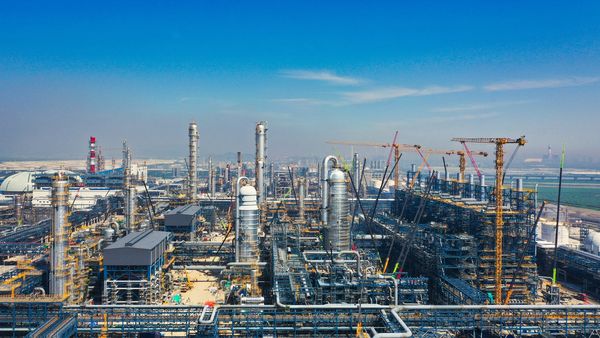
The emergence of large-scale refining capacity is accelerating that shift. The Dangote Refinery, now the largest single-train refinery in the world, is a central part of this transformation. With a processing capacity of about 650,000 barrels per day, the facility requires a steady and substantial supply of crude. That crude has to come from somewhere, and in practice, it is increasingly sourced domestically.
As a result, a growing share of Nigeria’s oil production is being diverted away from export markets and into local refining. This is a significant structural change. In the past, Nigeria exported crude and imported refined fuel, often at high cost. Today, the balance is shifting toward domestic processing. While this strengthens energy security and reduces reliance on imports, it also tightens the volume of crude available for export.
This refining push does not stop with a single facility. Efforts are underway to rehabilitate state-owned refineries and expand modular refining capacity across the country. Even if these projects progress gradually, they reinforce the same trend: more crude retained within the domestic system. In effect, Nigeria is becoming less of a swing exporter and more of a self-supplying energy system.
At the same time, production itself faces persistent limitations. Years of underinvestment have left critical infrastructure in poor condition. Pipelines are aging, maintenance is inconsistent, and operational efficiency is often below optimal levels. These issues are not easily or quickly resolved. Bringing infrastructure up to modern standards requires sustained capital, regulatory clarity, and time.
Security concerns further complicate the picture. The Niger Delta, which accounts for the bulk of Nigeria’s oil output, has long been affected by pipeline vandalism, theft, and disruptions from militant activity. While there have been improvements in surveillance and enforcement, the risk environment still affects production reliability. Operators must factor in potential losses and interruptions, which limits their ability to scale output aggressively.
Another critical factor is the absence of spare production capacity. In oil markets, spare capacity is what allows producers to respond quickly to disruptions elsewhere. It is the difference between operating at 70 percent and being able to ramp up, versus already running close to full capacity. Nigeria falls into the latter category. Current production levels are effectively the ceiling under existing technical and operational conditions.
Even where opportunities exist to increase output, they are not immediate. Reactivating shut-in wells, optimizing existing fields, and improving recovery rates can yield incremental gains. The government of Bola Tinubu has launched initiatives aimed at doing exactly that, including efforts to streamline regulations and attract investment. These steps are necessary and potentially impactful, but they take time to translate into actual barrels on the market.
Larger-scale production increases depend on new upstream projects, particularly in offshore and deepwater fields. These projects involve long development cycles. From investment approval to first oil, it can take several years. Engineering, procurement, construction, and installation all require careful planning and execution. Even in a high-price environment that encourages investment, the lag between decision and production means that new supply cannot arrive quickly enough to address an immediate crisis.
Financing is another constraint. Global energy investment patterns have shifted in recent years, with increased focus on energy transition and lower-carbon sources. While oil and gas projects still attract capital, competition is tighter, and investors are more selective. Nigeria must compete for that capital while also addressing concerns about governance, contract stability, and operational risk.
All of these factors combine to create a system that is already stretched. Rising domestic demand pulls more crude inward. Expanding refining capacity locks in that shift. Infrastructure and security challenges limit how much production can grow. And long project timelines prevent rapid scaling. The result is a country operating at or near its current limits, without the flexibility needed to respond to sudden global disruptions.
In the context of a potential supply shock linked to Iran and the Strait of Hormuz, this reality matters. Roughly a fifth of global oil trade passes through that corridor. Any sustained disruption would send prices higher and prompt buyers to search for alternative sources. Africa, and Nigeria in particular, is often part of that conversation. But expectations need to be grounded in operational reality.
Nigeria cannot simply increase output in the short term to stabilize global markets. There is no reserve of idle capacity waiting to be deployed. Instead, the country is balancing competing priorities: meeting domestic energy needs, supporting a growing refining sector, and maintaining stable production under challenging conditions.
Over the medium term, the outlook could improve. Continued investment, infrastructure upgrades, and regulatory reforms may unlock higher production levels. If refining capacity stabilizes and domestic supply chains become more efficient, Nigeria could eventually increase exports again. There is also potential in natural gas, where African producers may play a larger role in global supply, particularly for Europe.
But those are medium- to long-term dynamics. In the current moment, Nigeria is not in a position to act as a shock absorber for the global oil market. Its barrels are largely spoken for, its system is operating near capacity, and its priorities are increasingly domestic. In a time of global uncertainty, that leaves little room for the kind of rapid response that markets might hope for.