Skip to content

Sailing Iran’s ships turns risky after US submarine sank frigate

- Sri Lanka evacuates crew from another Iranian ship
Ziggy Ojiegbe
Sri Lanka has evacuated 208 crew members from an Iranian naval vessel off its coast following escalating maritime clashes involving Iranian and U.S. forces in international waters.

The evacuation came a day after 87 people were killed when a U.S. submarine struck an Iranian warship in the same region. Several others remain missing.
Sri Lankan President Anura Kumara Dissanayake said the government decided to assist the distressed vessel on humanitarian grounds.
“After detailed discussions with all parties, Sri Lanka has decided to assist the Iranian vessel,” Dissanayake told reporters in Colombo.
According to the president, those evacuated included 53 officials, 84 naval cadets, 48 senior sailors, and 23 sailors. Some crew members remained on board to help the Sri Lankan Navy guide the ship safely to Trincomalee Port on the island’s eastern coast.
The vessel was located near Colombo within Sri Lanka’s exclusive economic zone but outside its territorial waters.
“We acted on the principle that this is our humanitarian responsibility,” Dissanayake said.
The evacuation followed the sinking of the Iranian frigate IRIS Dena on Wednesday, about 19 nautical miles off Sri Lanka’s southern port city of Galle. Authorities said 87 bodies had been recovered from the sea, and two refrigerated containers were dispatched to store the remains.
Tehran has requested Sri Lanka’s assistance in repatriating the bodies, Sri Lanka’s Deputy Minister for Health and Mass Media, Hansaka Wijemuni, told Reuters. No timeline has yet been announced.
Iranian Foreign Minister Abbas Araqchi condemned the attack, saying the warship had been struck without warning in international waters thousands of miles from the Persian Gulf, where U.S. and Israeli forces are currently conducting strikes against Iranian targets while Tehran retaliates with missile and drone attacks.
“The U.S. will bitterly regret the precedent it has set,” Araqchi wrote on X, adding that the vessel had been participating in international naval activities.
According to officials, the IRIS Dena had taken part in a naval exercise organized by India in the Bay of Bengal from February 18 to 25 and was returning home when it came under attack.
Sri Lankan rescue teams responded to an early-morning distress call from the frigate and were able to recover 32 survivors. Search and rescue operations are continuing for about 10 people still missing.
The Indian Navy has also launched operations to support Sri Lanka’s rescue efforts.
The incident marks a dramatic escalation in the ongoing conflict.
U.S. Defense Secretary Pete Hegseth confirmed that an American submarine had struck the Iranian vessel.
“An American submarine sank an Iranian warship that thought it was safe in international waters,” Hegseth said at the Pentagon. “Instead, it was sunk by a torpedo.”
Defense outlet Warzone reported that the attack marked the first confirmed torpedo sinking of a warship by a U.S. submarine since World War II.
The report also said U.S. forces have struck or sunk more than 20 Iranian vessels since the conflict intensified. U.S. Central Command recently added a Soleimani-class missile corvette to that list after images appeared to show a ship burning near Bandar Abbas following U.S. strikes.
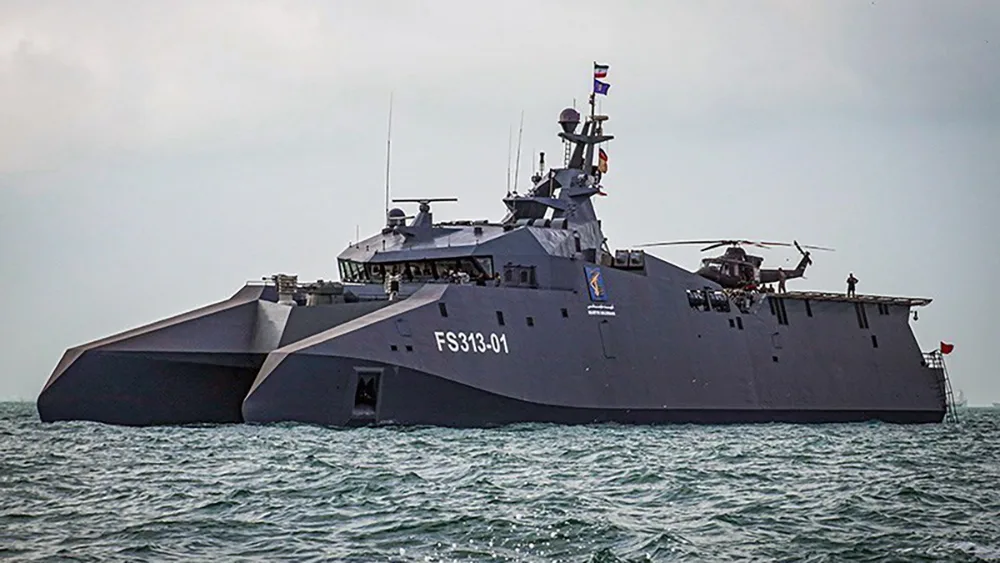
The Soleimani-class vessels are among the largest surface combatants operated by Iran’s Islamic Revolutionary Guard Corps Navy. They are typically equipped with surface-to-air missiles, close-in weapon systems, anti-ship cruise missiles, and facilities for drones or helicopters.
The first ship in the class, Shahid Soleimani, was commissioned in 2022 and features a vertical launch system capable of firing air-defense missiles.
However, in the confrontation with a U.S. submarine in international waters, the Shahid Sayyad Shirazi was unable to withstand the torpedo strike.
The vessel is named after an Iranian military commander whose death in a 2020 U.S. strike near Baghdad airport sharply escalated tensions between Washington and Tehran during the Trump administration.