Skip to content

WIEN wants women capacity integrated into upstream growth strategy

Sopuruchi Onwuka
As Nigeria intensifies efforts to raise crude oil production and attract fresh upstream investment, the Women in Energy Network (WIEN) is calling for deliberate policy reforms to ensure women-led exploration, production, and oilfield service companies are not excluded from emerging opportunities.
At the Sub-Saharan Africa International Petroleum Exhibition and Conference (SAIPEC) in Lagos, WIEN President, Mrs. Eyono Fatai-Williams, positioned gender inclusion as a strategic economic issue rather than a social campaign.
Mrs Fatai-Williams made its clear that expanding indigenous participation in Nigeria’s licensing rounds and emerging upstream projects must include structured pathways for women-owned firms.
 WIEN President, Mrs. Eyono Fatai-Williams
It would be noted that Nigeria’s petroleum industry is currently under official mandate to boost output, stabilize revenues, and deepen local capacity under the Nigerian Content framework.
The country’s oilfield acreage administrator, Nigerian Upstream Petroleum Regulatory (NUPRC), is currently priming processes for an imminent bid round for significant 50 exploration and production licenses in the petroleum industry. The bid round offers immense entry opportunities for new players and growth pathway for existing producing companies.
Whereas most of the corporate members of WIEN operate exploration and production licenses, majority of the individual members and women-led companies in the country operate outside the exploration and production league of the industry.
According to Mrs Fatai-Williams, ignoring women-led enterprises in the emerging licensing process for oil blocks amounts to leaving significant capacity untapped.
While acknowledging gradual improvements in gender representation since WIEN began its advocacy in 2020, Fatai-Williams argued that progress has largely remained at the level of public commitments.
Mrs Fatai-Williams declared that time has come to transcend industry diversity and inclusion narratives beyond mere advocacy to policy mechanisms.
“There has been more verbal response than action. Significant gender gaps still exist in the industry,” she said.
Executives of WIEN at the media briefing told journalists that the group wants concrete policy instruments rather than symbolic inclusion.

WIEN called for targeted commercial patronage for qualified women-led oilfield service companies; improved access to operating assets and exploration licenses; structured capacity-building support tied to measurable performance benchmarks; and regulatory incentives that encourage individual and consortium participation.
The group maintains that such measures would not lower standards but would correct structural barriers that limit access to capital, technical partnerships, and large-scale operating assets.
Oracle Intelligence reports that WIEN’s argument aligns closely with the objectives of the Nigerian Content Development and Monitoring Board (NCDMB), which has successfully nurtured indigenous companies into independent producers and globally competitive service providers.
Fatai-Williams commended the NCDMB’s local capacity development efforts but noted that women professionals and entrepreneurs remain a largely under-optimized segment of the indigenous capacity pool.
The policy question, according to WIEN, is whether Nigeria’s content development strategy will evolve to include gender-disaggregated capacity metrics and participation targets, especially as new licensing rounds and upstream projects unfold.
Beyond advocacy, WIEN says it is actively preparing its members to participate in the current licensing rounds, adding that its encouraging women-led firms to form consortia, pool technical expertise, and strengthen commercial readiness.
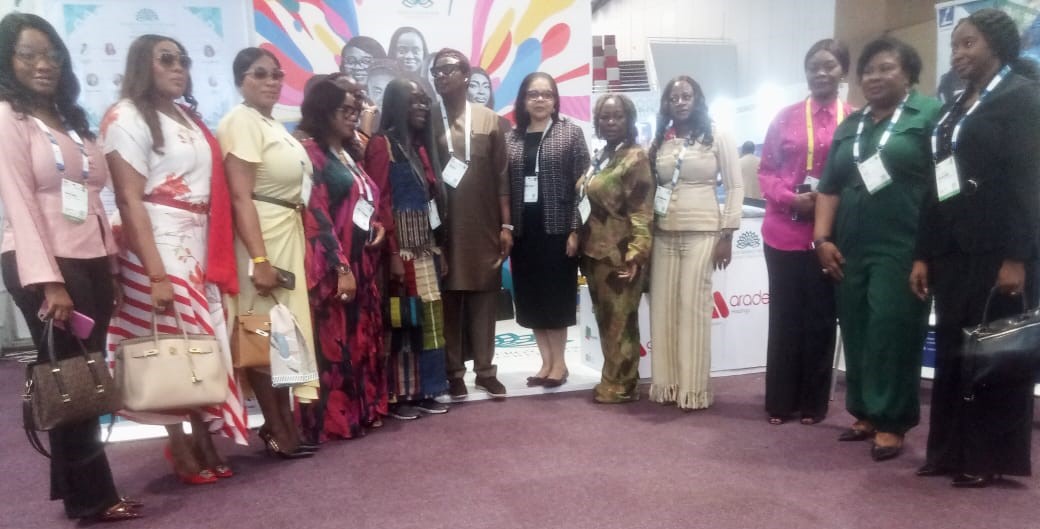
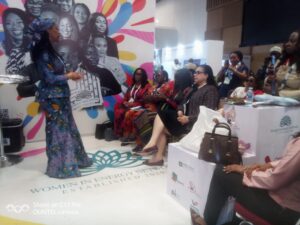 Founding President of WIEN, Mrs Funmi Ogbue, speaks at a brief session at WIEN exhibition booth at a conference in Abuja
“We are encouraging women to collaborate and take part in the licensing round. You must understand the technical, commercial, and fiscal requirements,” Fatai-Williams stated.
WIEN Executive Secretary, Engr. Asanimo Omezi, reinforced the point that the organization is not seeking pampering of preferential treatment.
“We are not asking for reduced standards, but for capacity building and opportunities that allow women-owned companies to compete effectively,” she said.
Omezi noted that the rapid rise of local oilfield service companies was driven by deliberate policy support and structured regulatory backing. In her view, replicating that model for women-led firms could unlock measurable production and service capacity gains.
WIEN’s Director of Partnerships and Conferences, Ms. Bassie Adie, framed the issue as one of systemic reforms. She called for policy adjustments that dismantle structural barriers that limit women’s access to senior roles, asset ownership, and high-value contracts.
“Change happens when you act,” she said, emphasizing the need for measurable outcomes rather than broad commitments.
Her remarks strongly infer that WIEN seeks more than increased headcount in leadership roles. They indicate that the organization is pushing for deeper integration of women into asset ownership, capital access, and upstream operations where strategic control and economic returns are concentrated.
With over 1,000 women-led companies, professionals, and associates under its umbrella, and approximately 30 corporate members including major oil and gas operators, WIEN represents a significant constituency within Nigeria’s energy ecosystem.
As Nigeria attempts to restore production levels and attract investment under its ongoing reforms, WIEN argues that inclusive growth goes beyond a simple matter of equity to form a capacity expansion strategy.
The broader policy debate, Oracle Intelligence reports, centers on whether regulators and government agencies will translate gender inclusion rhetoric into structured incentives, measurable participation frameworks, and enforceable implementation mechanisms within Nigeria’s evolving upstream architecture.
For WIEN, sustainable sector growth requires tapping every available pool of indigenous expertise, insisting that women-led companies are ready to compete, provided the system allows them a fair and structured entry point.