 Skip to content

Trump demands oil firms to invest more to recover Venezuelan assets

Ziggy Ojiegbe
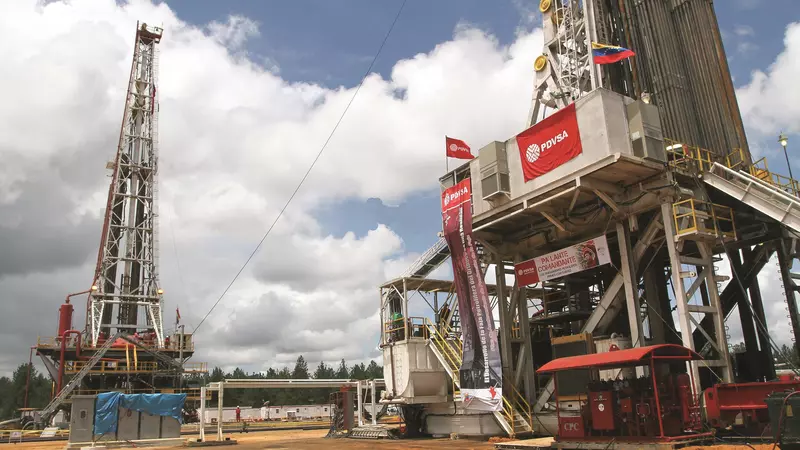
U.S. oil companies that lost assets to Venezuela’s nationalizations decades ago may get help recovering them — but only if they agree to reinvest heavily in the country’s battered oil industry.

Officials in the Trump administration have told oil executives in recent weeks that compensation for seized rigs, pipelines, and other infrastructure will depend on whether companies are willing to return to Venezuela now and finance the revival of its petroleum sector, local outlet POLITICO reported.
The outreach comes as Washington weighs the future of Venezuela’s oil industry following U.S. military operations that led to the capture of longtime leader Nicolás Maduro. Venezuela holds some of the world’s largest oil reserves, but years of mismanagement, sanctions, and underinvestment have left its infrastructure in severe disrepair.
Industry executives say the administration’s message has raised concerns rather than enthusiasm.
“They’re saying, ‘you’ve got to go in if you want to play and get reimbursed,’” said one industry official familiar with the conversations. “But the infrastructure is so dilapidated that no one can accurately assess what it would take to make it operational.”
President Donald Trump reinforced the message in a televised address on Saturday, saying he expects U.S. oil companies to spend billions rebuilding Venezuela’s oil infrastructure.
“We’re going to have our very large United States oil companies go in, fix the badly broken infrastructure and start making money for the country,” Trump said. “They will be reimbursed, but the upfront investment will come from them.”
Venezuela nationalized its oil industry in the 1970s, with major asset seizures expanded under former President Hugo Chávez nearly two decades ago. Since then, oil production has collapsed to less than a third of its 1970s peak of 3.5 million barrels per day, despite the country’s estimated 300 billion barrels of reserves.
Energy analysts and industry officials say the administration has yet to present a clear long-term plan.
“It’s not clear there’s been a specific strategy beyond the idea that, in a post-Maduro, Trump-aligned government, U.S. companies would be first in line,” said Bob McNally, a former energy adviser to President George W. Bush and head of Rapidan Energy Group. “What the regime looks like and how you get there hasn’t been fully fleshed out.”
Executives are also worried about worker safety, payment guarantees, oil price volatility, and Venezuela’s future relationship with OPEC. U.S. benchmark oil prices closed Friday at around $57 a barrel, their lowest level since the end of the pandemic.
The White House did not respond to questions about its oil strategy. Trump said at his Mar-a-Lago estate that companies would front the capital needed to restart production.
“We’re going to rebuild the oil infrastructure, which requires billions of dollars paid directly by the oil companies,” Trump said. “We’re going to get the oil flowing.”
Several executives described the administration’s engagement with the industry as preliminary and disorganized.
“In preparation for regime change, there had been some engagement, but it’s been sporadic,” said one executive who requested anonymity. “It feels very much like a shoot-first, aim-later approach.”
Discussions have also touched on the future of Venezuela’s state oil company, Petróleos de Venezuela (PdVSA). According to one industry source, there is currently no plan to fully privatize or dismantle the company, though its leadership would likely be overhauled.
Chevron, the only major U.S. oil company still operating in Venezuela under a special government license, said it remains focused on employee safety and compliance with U.S. laws.
Consultant Evanan Romero, who is involved in efforts to bring U.S. producers back to Venezuela, said recent events could accelerate American reentry. Romero is part of a group of former PdVSA employees exploring how to revive the industry under a new government.
Former Trump administration officials say political stability will be key to attracting investment.
“It’s not just about removing Maduro,” said Carrie Filipetti, a former State Department official. “There has to be an orderly transition that puts a legitimate opposition government in power.”
Others argue Washington could use financial tools to reduce risk for investors. Richard Goldberg, who previously led the White House’s National Energy Dominance Council, said agencies such as the Export-Import Bank and the U.S. International Development Finance Corporation could help underwrite projects.
Promoting U.S. investment, Goldberg added, would also limit China’s influence and curb its purchases of discounted Venezuelan crude.
Still, analysts caution that Venezuela remains a long-term bet. With oil prices hovering near $50 to $60 a barrel and massive capital investment required, many companies are reluctant to move quickly.
“Venezuela would be a crown jewel if the political risk is removed,” said Landon Derentz of the Atlantic Council. “But right now, companies are watching closely and waiting to see how this plays out.”


