Skip to content

Korean scientists evolve novel treatment to remove liver fat

- U.S. study finds high-fat diets linked to liver cancer risk
Ziggy Ojiegbe
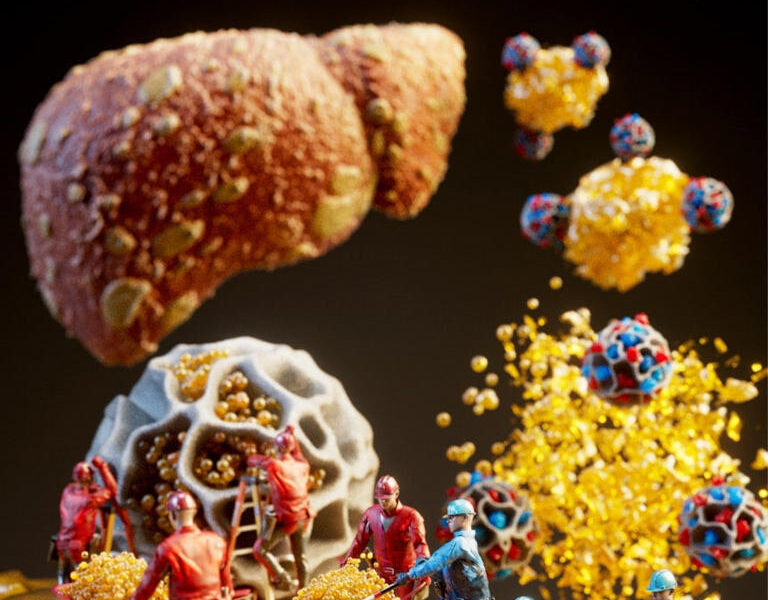
A joint research team from the Korea Institute of Science and Technology (KIST) and Hanyang University has developed a new therapeutic approach that directly removes fat accumulated in liver cells, offering a potential breakthrough in the treatment of fatty liver disease.

The study, selected as a cover paper by the international journal Advanced Materials, was led by Dr. Lee Hyun-beom and Dr. Park Jin-young of KIST’s Center for Biomolecular Recognition, together with Professor Lee Jun-seok and Professor Jeon Dae-won of Hanyang University.
Fatty liver disease occurs when excess fat builds up inside liver cells, often without noticeable symptoms in its early stages. If left untreated, it can progress to hepatitis, cirrhosis, or liver cancer. Despite its growing prevalence, effective drugs that directly eliminate liver fat have been lacking. Current treatments largely rely on lifestyle changes or medications that indirectly regulate fat metabolism.
The research team targeted “lipid droplets,” the microscopic fat storage units that accumulate inside liver cells. Higher numbers of lipid droplets are associated with increased inflammation and liver damage.
To address this, the scientists developed a nano-sized therapeutic agent called LDI (Lipid Droplet Inhibitor). LDI combines a fat-binding compound with a fat-degrading enzyme. Once inside liver cells, it attaches to lipid droplets, prevents them from enlarging, and breaks down fat that has already accumulated, directly targeting the underlying cause of fatty liver disease.
Animal experiments showed promising results. Mice with fatty liver disease that received LDI injections experienced significant reductions in liver fat and inflammation. Indicators of liver damage improved by as much as 84 percent, and researchers reported minimal toxicity or serious side effects.
Industry experts say the treatment represents a new direction in fatty liver therapy. While GLP-1–based obesity drugs help reduce fat accumulation indirectly by promoting weight loss, LDI is designed to actively remove fat already present in the liver.
Dr. Lee Hyun-beom of KIST said the findings open the door to new treatment strategies. “Fatty liver disease has long lacked effective therapeutic options. This research presents a new path toward restoring liver health, and we aim to advance it toward clinical application,” he said.
The Korean findings come amid growing concern over high-fat diets, particularly the ketogenic diet. A recent U.S. study published in the journal Cell warns that long-term consumption of high-fat, low-carbohydrate diets may significantly increase the risk of liver cancer.

Researchers found that repeated exposure to high-fat diets caused liver cells to shift into a more primitive, stress-resistant state. While this adaptation helps cells survive excess fat, it also makes them more vulnerable to cancer-causing mutations.
“If cells are forced to deal with a stressor like a high-fat diet over and over again, they may survive in the short term, but at the cost of increased susceptibility to tumor formation,” said Professor Alex Shalek of MIT, a senior author of the study.
In experiments, nearly all mice fed a high-fat diet developed liver cancer within a year. Although the disease develops more slowly in humans—often over two decades—the researchers warned that factors such as alcohol consumption, viral infections, and overall health can accelerate the process.
The study also found that patients with advanced liver disease who showed higher activation of survival-related genes and reduced expression of normal liver-function genes had poorer survival outcomes after cancer developed.
A ketogenic diet typically consists of about 75 percent fat, 20 percent protein, and just 5 percent carbohydrates, a sharp contrast to balanced diet guidelines that recommend much lower fat intake. Despite growing evidence of health risks, the diet remains popular, including among high-profile celebrities.
Liver disease is increasingly affecting younger adults and non-drinkers. In the UK, estimates suggest up to one in five people may have fatty liver disease, with experts warning the true figure could be even higher. Most cases go undiagnosed due to the lack of early symptoms.
Researchers hope that early intervention, dietary changes, and emerging treatments—including GLP-1 weight loss drugs—could help reverse liver damage and reduce cancer risk.