Skip to content


Flare gas commercialization: Policy targets, jubilant licensees and investment reality

- NCDMB’s KGG provides credible accelerator model to NUPRC
Sopuruchi Onwuka
Federal government is getting increasingly impatient with the slow progress made by the licensees of the Nigeria Flare Gas Commercialization Programme (NGFCP), threatening to revoke their awards of access to flare gas at the nation’s oil production sites; but experts warn that more careful examination of the issues that originally deterred the operating companies from taking commercial advantage of flare gas might be the starting point for performance evaluation.
The indication that government’s patience with the slow pace of domestic gas monetization has officially run out came after no significant progress has been recorded from the 27 of the 43 flare gas sites awarded by the Nigeria Upstream Petroleum Regulatory Commission (NUPRC) under the NGFCP.
The Commission Chief Executive of the NUPRC, Mrs. Oritsemeyiwa Eyesan, related her disappointment with the slow implementation progress during a briefing with the Minister of State for Petroleum Resources (Gas), Rt. Hon Ekperikpe Ekpo.
While Rt. Hon. Ekpo has repeatedly pointed at progress in the country’s gas agenda, the actual monthly flare volumes continue to increase, the domestic market for cooking gas continues to suffer severe supply shocks that spike prices, and the government’s fuel diversification programme appears to yield diminishing impact.
The NGFCP is one of the several longstanding policy programmes that aim to convert produced gas into usable fuel products and help cushion local supply shocks, cut dependency on petrol, diversify fuel options and enhance oilfield environmental performance.
In presenting an update to the minister on the NGFCP, Mrs Eyesan lamented that “One year after an award has been granted, the Commission conducts an evaluation to determine whether there has been considerable progress.
“Where there is insufficient progress, the Commission will take appropriate regulatory action, including revocation of the award where necessary,” she warned.
Oracle Intelligence reports that the CCE’s briefing with the minister pointed to disquiet with the policy circles over the glaring stall in implementation of the NGFCP which, Mrs Eyesan noted, lays compelling basis for power generation, industrialisation, exports and broader economic development.
Nigeria’s quest for ending routine flaring of associated gas at oil production sites has remained one of the most difficult policy programmes in the country’s petroleum industry where players and government agencies are constantly at debate over fiscal and commercial terms for taking difficult tasks in generating value from gas resources.
The NGFCP is just one of several gas policies and programmes that have been churned out by government for the industry in the past two decades; yet gas development projects remain primarily driven by commercial initiatives of operating companies.
In trying to address the environmental consequences of heavy emissions from flare booms at the nation’s numerous oil production sites, government has pumped out legislations, regulation, orders, policies and programmes for gas valorisation.
From Associated Gas Fiscal Arrangements (AGFA) through Non-associated Gas Fiscal Reforms Act (NAGFRA), Nigerian Gas Masterplan, Gas Revolution, National Gas Policy, NGFCP, and now Decade of Gas programme; players in the industry determine for themselves the flare reduction models that deliver returns on invested funds.
Over the years, several policies and programmes designed to channel natural gas away from flare booms to homes and businesses have yielded limited results, but have, in turn, indicated strong commercial viability for potential investments in gas monetization.
A strong example is the Nigeria Liquefied Natural Gas (NLNG) Limited which has remained one of Africa’s most commercially viable gas projects, yielding robust cash dividends to all stakeholders, supporting government’s annual fiscal expenditure plans, contributing significantly to the liquidity of domestic foreign exchange market, and helping meet domestic demand for clean cooking fuel.
Some of the successful gas monetization projects also laid compelling proposition for the government to modify its series of policies for ending routine flaring of associated gas to not only earn money and meet domestic fuel demand, but also to minimize carbon emissions in line with demands by multilateral lenders for supporting local petroleum projects.
Thus, from the policy angle, regulators have vehemently maintained that every flare gas identified for commercialisation can become a sustainable business that aligns with long declared national ambition to position gas resources as equal revenue earner with liquid petroleum.
But players continue to point at the greater challenges of technical feasibility, venture bankability, infrastructure base and commercial terms that rule investment decisions.
According to a conference paper he delivered at Gas & Oil Technology Showcase and Conference hosted by Society of Petroleum Engineers (SPE), Martin CEng Oakley stated that recovery and monetization of flare gas and other rich gas sources through innovative new technologies are possible but difficult.
He explained that flaring of rich gas, or gas rich in heavy hydrocarbons (C3+), has remained frequent occurrence in oil and gas production.
While heavy hydrocarbons are often considered impurity in natural gas for producers looking to harvest lighter methane (C1) and ethane (C2), he clarified, the rich gas also carries high commercial viability that confers profitability on flare gas monetization investments.
He described wellhead gas as a mixed composition ranging from methane through the heaviest hydrocarbons, as well as impurities such as H2O and H2S.
Martin Oakley stated in his paper that “these types of unrefined gas can be difficult to monetize,” adding that existing methods of separation technologies struggle to deal with the unique combination of factors which are associated with flare gas.
He added that fractionation plants are large and expensive and therefore often uneconomic or impractical to construct where consolidated gas streams are not available.
Oracle Intelligence reports that the situation is directly the opposite in Nigeria where the greatest impediment to flare gas valorization has less to do with the quality of wellhead gas but more to do with availability of shared infrastructure.
According to the Chairman of Oida Energy Group, an industry technology solutions provider, Mr Emeka Ene, the first issue regarding the economics of rich gas is separation of specific components from raw wellhead gas to produce specification products.

Mr Ene who is a former President of the Nigerian Council of SPE, pointed out that some of the earliest attempts at monetizing flare gas in Nigeria involved huge financial outlay for infrastructure development, processing facilities and field-to-market pipelines.
The Kwale Gas Gathering facility developed and delivered by Oida affiliate, Xenergi Limited, resolved the concerns about gas monetization investment, technology solutions, commercial terms, tariff regimes, and market access for cluster producers contiguous to the gas processing hub.
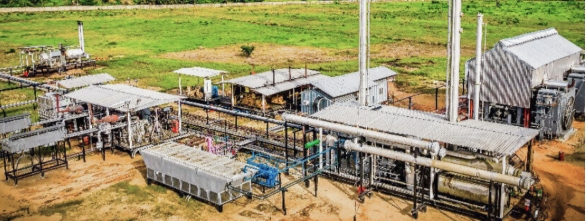
Next layer of flare gas commercialization in that axis has been conceived by Phoenix Limited to completely eliminate gas flares in the Kwale production cluster and optimize the existing KGG facility in connecting all gas from cluster operations through the Obiafu-Obrikom-Oben (OB3) gas trunkline to market.
The huge financial requirement for developing pipeline and sundry infrastructure to connect variegated oilfields spread across sedimentary basins to the market explains why the biggest gas monetization projects in the country were undertaken by deep pocket multinational giants like Shell, TotalEnergies, Eni, ExxonMobil and Chevron.
While Shell leads TotalEnergies and Eni in the country’s gas liquefaction and export joint venture and also operates the Nigeria LNG Limited; Eni had separately invested significantly in gas-to-power; ExxonMobil in gas fractionation; Chevron in gas-to-liquids (GTL) and export pipeline; and TotalEnergies in gas treatment facilities.
With the divestment of their onshore assets in the country, Eni and ExxonMobil have since transferred their gas monetization facilities to successor companies including Oando and Seplat Energy Plc. Shell has retained its midstream and downstream gas portfolio in the country while its numerous successor companies in the upstream business continue to sell feedgas to the NLNG Limited.
Among the multiplicity of indigenous players in the upstream petroleum industry, only Seplat and affiliated companies including Platform Petroleum and Pillar Oil continue to consistently develop and deepen the domestic gas market through targeted and strategic investments in the evolving domestic gas market.
However, these long gestation investments by Seplat, Pillar Oil and Platform are totally not tied to the NGFCP. Instead, they are products long term commercial outlook and strategic positioning.
The only successful flare gas monetization programme by an indigenous company is the Kwale Gas Gathering (KGG) facility the development of which was delivered by the Oida Energy Group in joint venture with the Nigerian Content Development and Monitoring Board (NCDMB) in Delta State.
Ironically, the KGG was also not delivered on the platform of government’s flare gas commercialization programme, demonstrating graphically that delivering government’s policy targets requires workable commercial arrangements that transcend mere licensing.
Oracle Intelligence learnt that more flare gas commercialization projects are being negotiated across the industry landscape but based more on the commercial concepts supporting private investments like the KGG model than the stalled NGFCP.
Chairman of AA Holdings, Mr Austin Avuru, explained in a chat with Oracle Intelligence that licensees of the NGFCP must go beyond securing government’s license to access flare gas produced by third parties and confront the challenges of exploring evacuation of lean gas to national gas grid.

Mr Avuru who is the founding Managing Director of Platform Petroleum and also the founding Managing Director of Seplat Energy Plc noted that both companies took early positioning in the gas sector when it became clear that the world is turning to gas as more acceptable energy source.
He stated that whereas stripping valuable liquids from rich gas carries significant commercial lucre, managing the lean gas would require investments in evacuation facilities. He made it clear that investment in shared industry infrastructure currently presents new investment opportunities as the NFGCP generates enhanced momentum.
But there are more investment challenges in flare gas monetization, Oracle Intelligence reports.
Martin Oakley stated in his paper that other traditional small-scale solutions are limited, recovering only part of the gas or producing inconsistent flows and products which are difficult or inefficient to monetize.
According to him, “flare monetization technology needs to efficiently and cost effectively process associated gas at the well-site, separating the rich gas into usable products. It must be modular, mobile, and scalable and capable of managing the ebbs and surges of oil wells, allowing delivery of product at a consistent flow rate and pressure.
“By combining flow control, compression, and mechanical refrigeration with advanced monitoring and control, GTUIT can produce stable products that can be directly monetized through various routes depending on user requirements, local markets, and geographic restrictions.
“With the right flare monetization technology, rich gas can be processed into a clean, high methane number gas for electric power generation, or processed into CNG and LNG.
“Additionally, extracted Natural Gas Liquids can be sold directly to market or combined into crude oil streams,” Oakley declared in his paper.
The technical and operating conditions prescribed in Oakley’s paper entails that the flare gas licensee is also the operator of the oilfield. And this is a different scenario from the NFGCP where the licensee is not the gas producer.
It is only logical and economic that an operator who produces rich gas from his assets finds additional commercial opportunity in monetizing all his valuable output, including oil, condensate and lean gas.
Full resource monetization is becoming the model in the Nigerian upstream petroleum industry operations considering the rising domestic demand for natural gas, market value of NGLs, gas flare penalties and environmental regulations.
Companies like Shell, TotalEnergies, Chevron, Eni, Seplat, Platform and Oida Group have amply demonstrated the feasibility of gas commercialization where the conditions are congenial. And they have taken commercial opportunities purely as business decisions, without incentives or licenses under existing gas programmes.
In resolving the low progress of the NFGCP, therefore, government regulators and licensees must first find out why an oilfield operator who produces rich gas is unwilling to stake further monetization investments. It is in understanding why a producer is willing to give away his gas output or burn it away at the risk of financial penalty that the enormous challenges confronting the NFGCP licensees become clearly visible.
The situations that provide opportunities for the flare gas investor are ultimately the challenges the producer is unable to resolve. And worse than original circumstances is dependency of the flare investor on the fate of the producer.
Whereas the licensing arrangement is assumed to provide reliable outlook on feedstock production profile, the investment fundamentals including stability of production and asset field life all fall outside the control of flare gas investors.
Also, as Martin Oakley stated in his paper, harnessing flare gas for monetization entails technology interface between the producer’s facilities and those of the flare gas licensee to ensure little or no technical glitch in superimposing modular gas processing facilities on existing production facilities.
Resolving the operating interface entails that the flare gas investor would among other things liaise with the producer on many issues including sustainable feedstock, host-facility interfaces, operating concept, and other technical details.
According to experts who spoke to Oracle Intelligence on the matter, the flare gas permit holder requires to manage coordination of an intricate web of connectivity with the producer, ensuring that his personnel and facilities align with existing production systems in a manner that does not disrupt the operations of the producer.
There is also concern about the quality of the produced gas. The flare gas investor must be certain that output from his operations is awaited by the market, and that the means of evacuating liquid and lean gas products are technically and commercially feasible and bankable.
Whereas these complex challenges exist, experts say that the commercial viability of flare gas valorization remains bright, citing examples of KGG and other projects including the UTM FLNG project which is being accelerated to take advantage of stranded offshore gas.
These successful pioneer projects do not by any means subtract from the enormous challenges that currently prove that commercializing flare gas is not plug-and-play opportunity. It commands complex project execution strategies with a significant investment cash call for development of gas infrastructure. Therefore, investments require a clear commercial feasibility that takes returns on investment into account.
With existing fractionation plants now in the operations of Seplat Energy Plc, Xenergi’s Nidogas and KGG and ongoing Phoenix projects providing models for flare gas monetization, NFGCP still holds significant potential to assist government derive financial and economic benefits from flare gas while also cutting emissions from Nigeria’s oilfields.
With a gas minister now in place for the second time in the history of the Nigerian petroleum industry, Hon. Ejperikpe Ekpo who is yet to deliver any palpable impact in the industry must seize the opportunity to harness demonstrable local capacity and expertise in providing a clear pathway for the NFGCP licensees to follow.
Mrs Eyesan also has the opportunity to copy the role of the NCDMB in the KGG project which has won the country an outstanding innovation award at the 2025 International Gas Union (IGU) conference.
Nigeria does not lack credible technical capacity and investment astuteness in the gas industry. All it takes is for the policy drivers to consult and engage those that already walked the path; not for the benefit of the flare gas licensees but for evolution of credible investment and operating models that would propel the policy objectives on the NFGCP towards full realization.
To truly rescue the country’s gas agenda, curb cooking gas supply shocks, and enhance environmental performance of the industry, the Federal Government must pivot away from punitive enforcement and instead actively incentivize the development of shared regional infrastructure hubs, transforming scattered, unmarketable flare sites into collaborative, commercially viable energy clusters.