Skip to content

Nigeria Prize for Science records historic 237 entries after NLNG mobilizes global innovators for Nigerian solutions

The 2026 edition of The Nigeria Prize for Science and Innovation has recorded its highest number of submissions since inception, with organisers receiving a record 237 entries as interest grows around the country’s evolving technology and innovation ecosystem.
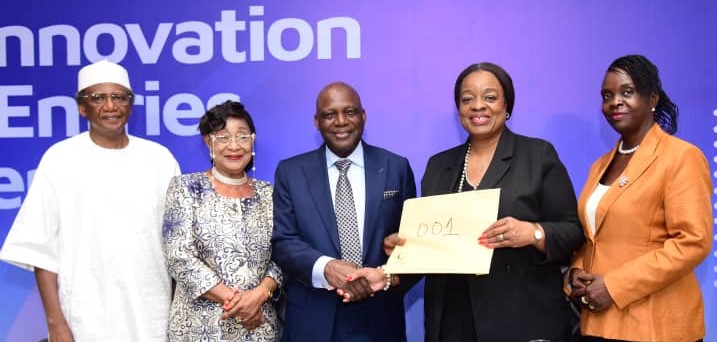
The submissions were formally handed over to the Prize’s Advisory Board during a press conference held in Lagos on Thursday, marking the commencement of the adjudication process for what organisers described as a highly competitive edition.
This year’s competition is themed “Innovations in ICT, Artificial Intelligence (AI), and Digital Technologies for Development,” a theme retained from the 2025 edition, which ended without a winner after no entry met the standard required for selection.
Speaking at the event, the General Manager, External Relations and Sustainable Development at Nigeria LNG Limited (NLNG), Mrs. Sophia Horsfall, said the decision to maintain the focus on digital innovation reflects both global technological shifts and Nigeria’s development priorities.
According to her, the Prize remains committed to identifying solutions capable of addressing practical challenges and delivering measurable impact.
“In this fourth revolution, digital infrastructure is as foundational to our survival as electricity or water. For Nigeria, our economic sustainability depends on our ability to move beyond promising research and into undeniable innovation that delivers,” she said.
Horsfall noted that international recognition for Nigerian innovation can only be achieved through strict adherence to quality and credibility standards.
“We believe that if a Nigerian discovery is to command global respect, it must withstand the highest levels of scrutiny. It is this conviction that guided the difficult decision seven months ago,” she added, referencing the decision not to award a winner in the 2025 edition.
While acknowledging the strong interest generated by the competition theme, she maintained that only entries demonstrating scalability, originality, and practical relevance would be considered during the evaluation process.
Receiving the submissions on behalf of the Advisory Board, Chairman of the Board, Professor Barth Nnaji, described the handover as a critical stage in the Prize’s selection process and reiterated that the integrity of the award rests on maintaining rigorous standards.
“Our refusal to award the prize in 2025 was not a dismissal of the hard work of Nigerian innovators; rather, it reinforces that The Nigeria Prize for Science and Innovation holds a gold standard of excellence,” he stated.
Nnaji explained that the absence of a winner in the previous edition should be understood within the context of the Prize’s demanding assessment framework, which prioritises originality, technical depth, relevance, and demonstrable societal impact.
He stressed that all submissions for the 2026 edition would undergo thorough intellectual and technical scrutiny to ensure that only truly outstanding innovations emerge.
According to him, the broader objective of the Prize is to identify scientific and technological solutions capable of addressing real-life national challenges.
“Our broader objective is to identify work that brings tangible impact to the challenges Nigeria faces, whether through digital health technologies that serve rural populations or the use of AI in preserving our cultural heritage and languages,” he said.
Other members of the Advisory Board include Chief Dr. Nike Akande, a two-time former Minister of Industry, and Professor Baba Yusuf Abubakar, a professor of quantitative genetics and animal breeding.
Now in its 22nd year, The Nigeria Prize for Science and Innovation is valued at $100,000 and is widely regarded as one of Africa’s most prestigious science awards. Organisers said the winner of the 2026 edition will be announced at a world press conference scheduled for September.