Skip to content

M/East conflict: Iran, Nigeria, others count losses

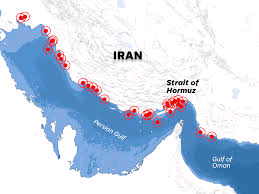
Nearly three weeks into the enforcement of a United States’ naval blockade in the Strait of Hormuz, restricting all ships originating from and entering Iranian ports, the Wall Street Journal (WSJ) has calculated that the development may be costing Iran up to USD 435 million a day, significantly affecting its crude oil and petrochemical exports.
However, for the rest of the world, especially Nigeria, the economic climate looks war-torn already, with soaring inflation figures and cost of living, poverty reaching ballistic levels, all as a direct result of the conflict in the Middle East.
The decision to block Iran’s access to the Strait of Hormuz was announced on Sunday, April 12 by the US President, Donald Trump but enforcement by the military command commenced on May, August 13.
The US government’s move targets the disruption of Iran’s crude oil export and shipping sector to economically impact the nation, and force the country to the negotiating table and effectively end the conflict which broke out on February 28, this year.
Iran is battling a coalition of US and Israeli forces over the country’s continued insistence on pursuing a controversial nuclear arms programme to the discomfort of the comity of Gulf nations, as well as Israel.
According to the report, this whopping estimated losses also includes the sum of USD 276 million in lost exports, primarily crude oil and petrochemicals.
The estimate by Miad Maleki, an analyst with the Foundation for Defense of Democracies research group, was based on Iran exporting 1.5 million barrels of oil a day at around USD 87 a barrel during the war, reported the media house. As per the estimate, 90 per cent of Iran’s exports might have been through Kharg Island, which was reportedly bombed by the US last month.
Meanwhile, other analysts also presume that the economic impact of the US naval blockade on Iran will depend on several other factors, including how much intensity the US forces can restrict ships leaving or entering Iranian ports. or whether Tehran could trade through alternative routes. The Jask terminal could be one of the alternative routes that Iran could explore, but it also has some limitations.
It is generally agreed that the short-term damages could be negated by oil Iran already has on the water, as it is claimed that Iran had an estimated 154 million barrels floating outside the Strait as of late March, in anticipation of a US blockade.
The US naval blockade is applicable to all the ships leaving and entering Iranian ports, including those on the Arabian Gulf and the Gulf of Oman but with no restrictions on ships originating from non-Iranian ports.
For the rest of the world, the economic environment has become increasingly volatile with rising frequency of major shocks worldwide since the blockade.
Global oil prices have already surged by more than 50 percent as of late March. In addition, disruptions linked to Gulf energy supplies limit access to ammonia and urea during the critical March–May planting season.
Economic experts posit that immediate the consequences of this war on Africa will more like impact on agricultural production, compounding risks of crisis and emergency levels of food insecurity, especially for low‑income households and import‑dependent economies.
As it is, the now over two-month old impasse has sent economic shockwaves to countries and continents beyond the Middle East with spikes in energy, food and fertilizer prices resulting from the house war felt in Nigeria, as well as the rest of Africa.
With Nigeria’s foreign reserves plummeting, domestic petrol and liquefied petroleum gas (LPG) prices skyrocketing, the impact of the Iran war is steadily disrupting households’ expenditure plans and reshaping cost of living in the country.
This is even as the Organisation of Petroleum Exporting Countries (OPEC), had raised Nigeria’s production ceiling to about 2 million barrels of crude oil per day, and in addition to the country’s high in demand crude variety witnessing significant spikes in international prices.
However, on the domestic scene, households continue to strain under the direct impact of the Middle East conflict as reflected in the Q1, 2026 report of the National Bureau of Statistics (NBS) report which out the average cost of cooking gas (LPG) hovering around N1500/kg since the war broke out, while premium motor spirit (PMS) or petrol which sold for around N850/litre ex-depot before the conflict now shuttling for between N1300 and N1500/litre. The worst hit may well be aviation fuel, also called JET-A1 which domestic airline operators is threatening to force them to shut down operations owing to its rising cost.
Nigeria’s gross external reserves stood at $48.45 billion as of April 24, 2026, according to the latest Central Bank of Nigeria (CBN) data, a figure representing a slide from about US$ 1.57 bn since March 11, when reserves hit a 17-year high of US$50.02 billion.
Reserves slipped from $50.03bn on March 11 to $48.65bn by April 16, then to $48.45bn by April 24. And the CBN has yet to provide an official reason, analysts point to ongoing FX market interventions to stabilize the naira which had come under heightened pressure since the outbreak of the Iran war.
Nigeria’s Reserves had been climbing steadily since mid-2025, rising from $37.21bn in June 2025 to over $48bn by February 2026.
Across Africa, it is reported that the war itself has weakened 29 currencies, with Nigeria not exempted, further raising the cost of servicing external debt or strengthening capital expenditure in affected countries.
It would be recalled that, early last April, on the sidelines of the 58th Session of the Economic Commission for Africa in Tangier, Morocco, economic experts from the four institutions discussed the implications of the conflict on African economies and highlighted the key findings and recommendations of the forthcoming report.
The experts drawn from the African Development Bank (AfDB) the African Union Commission (AUC) the United Nations Development Programme (UNDP), and the UN Economic Commission for Africa (UNECA) outlined practical recommendations for crisis responses and resilience building in African countries.
“Continued escalation of the conflict worsens global instability, with serious implications for energy markets, food security, and economic resilience, particularly in Africa where economic pressures remain acute” H.E. Mahmoud Ali Youssouf, Chairperson of the African Union Commission.
According to the experts, the current shocks are transmitting faster and through more concentrated channels than past global disruptions, leaving African economies with little time to adjust. Its effects are already affecting African economies and households, requiring rapid effective policy action.
Continuing, Mr Claver Gatete, the United Nations Under-Secretary-General and Executive Secretary of the United Nations Economic Commission for Africa, the continent has been hit by too many external shocks not of its making, which calls for decisive action, to protect people now, but also to accelerate Africa’s long‑term push towards energy security, food sovereignty, and financial self-reliance.
“Crises like this reinforce why Africa must finance more of its own future and strengthen regional solutions that build resilience before the next shock hits,” he added.
“This moment demands leadership, within Africa and from its partners,” stressed Ahunna Eziakonwa, the United Nations Assistant Secretary‑General and Director of UNDP’s Regional Bureau for Africa, adding; “With the right mix of policy choices, financing tools, and political resolve, Africa can weather this shock and emerge more resilient, more self-reliant, and better positioned to shape its own economic future.”
According to the report of the experts, immediate crises responses should include; measures to cushion households and stabilize fuel, food, and fertilizer supply by African governments and supported by development partners and the private sector.
Also, there should be; medium-term reforms to strengthen energy security, targeted social protection, and regional trade under the AfCFTA; long-term structural reforms towards stronger domestic resource mobilization and African financial safety nets, including accelerated implementation of the African Financing Stability Mechanism.
“As global crises multiply, Africa’s response must evolve from managing shocks to fostering resilience,” emphasized Sidi Ould Tah, President of the African Development Bank Group, adding; “African institutions and development partners need to act swiftly and in concert, leveraging their comparative advantages to cushion short-term shocks while laying the foundations for long-term resilience.”
By strengthening regional integration, accelerating African-led financial solutions, and investing decisively in energy, food, and trade resilience, the continent can move from vulnerability to preparedness.
It would be recalled that late March, the US President, Mr Donald Trump ordered a naval blockade in the Strait of Hormuz with the deployment of at least 15 warships, the US Central Command, which supervises operation confirmed.