Sadiq Umar
Millions of people in Haiti are facing worsening hunger, displacement and violence as the country sinks deeper into what the United Nations Office for the Coordination of Humanitarian Affairs has described as one of the most severe humanitarian crises in the Western Hemisphere.
Ad >>>

Edem Wosornu warned that conditions have deteriorated sharply, with armed gangs maintaining control over large parts of the country and driving widespread insecurity. Speaking after a recent visit, she said more than half the population, around 6.4 million people, now require humanitarian assistance, while 5.7 million are struggling with hunger.
Families are increasingly skipping meals, and in many cases children are leaving school to help support their households, as the crisis deepens. At the same time, displacement has surged, with about 1.5 million people, roughly 12 percent of the population, forced to flee their homes.
“These are not abstract figures,” Wosornu said, stressing that the numbers reflect real families who have been uprooted, separated, or left without shelter.
The situation is particularly dire in Port-au-Prince, where gangs are estimated to control around 90 percent of the city. Violence has also spread beyond the capital. In the Centre Department, a recent wave of attacks killed about 80 people and displaced 13,000 others.
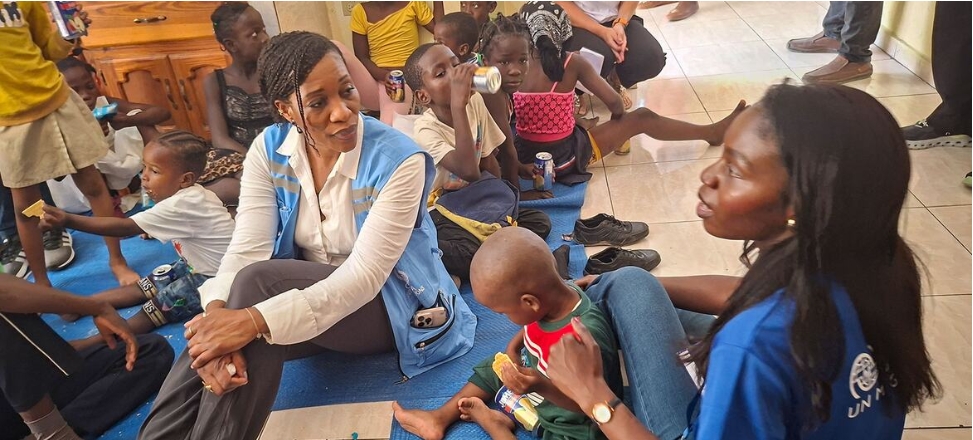
Wosornu described visiting overcrowded displacement sites where living conditions are extremely harsh. In one location, a school designed for 400 students was housing nearly 2,800 displaced people. Many are sleeping on bare ground, exposed to poor sanitation, vermin, and disease.
The country’s education system has been severely disrupted, with about 1,600 schools closed due to insecurity, leaving an estimated 250,000 children without access to learning.
Women and girls are among the most vulnerable. The number of reported cases of gender-based violence rose to more than 8,100 last year, a 25 percent increase from the previous year, with half involving rape. One in six survivors is under the age of 18.
Wosornu recounted meeting a 16-year-old girl caring for her three-month-old baby after being abused by a man who had offered her shelter. The teenager, displaced and separated from her family, had nowhere else to turn.
Despite the scale of need, only about 30 percent of survivors receive medical or psychological care within the critical first 72 hours, largely due to a lack of funding.
Humanitarian organisations continue to operate under extremely difficult conditions, often negotiating access with armed groups to deliver aid. Many aid workers are themselves affected by the crisis but continue their work.
The UN and its partners are seeking $880 million to assist 4.2 million people in Haiti this year, but less than 20 percent of the required funding has been received.
Wosornu called for urgent international action, including an end to the violence, increased humanitarian support, and political solutions to address the root causes of the crisis.
“Humanitarian assistance alone cannot change the fate of the people of Haiti,” she said, warning that without sustained support and long-term solutions, conditions will continue to deteriorate.



 Skip to content