Skip to content

Ground offensive looms as Trump deploys additional war ships, troops

Frank Okon
The United States is increasing its military presence in the Strait of Hormuz as Washington and its allies work to restore safe passage for global oil and cargo shipments.

The narrow waterway, which carries roughly a fifth of the world’s oil supply, has become a focal point in the escalating conflict between the United States and Iran. Recent Iranian attacks and military activity have disrupted commercial traffic and raised concerns about the stability of energy supplies from the Gulf.
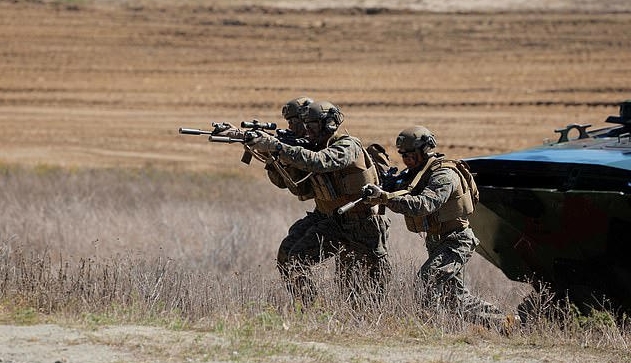
U.S. Defense Secretary Pete Hegseth approved the deployment of a Marine Expeditionary Unit to the region following a request from United States Central Command, according to officials cited by The Wall Street Journal. Such units typically include several warships and about 5,000 Marines.
Among the forces heading to the Gulf is the USS Tripoli (LHA-7), an amphibious assault ship capable of launching aircraft and supporting maritime security operations. The vessel and its Marine contingent are expected to join other U.S. forces already operating in the region.
Military officials say the buildup is aimed primarily at protecting international shipping lanes and ensuring that commercial tankers can safely pass through the Strait of Hormuz. Additional naval patrols, air cover, and escort missions for commercial vessels may be expanded in the coming days as part of efforts to stabilize the waterway.
The deployment comes as fighting between the United States and Iran intensifies. U.S. officials say the American death toll in the conflict has reached 13 service members, while more than 140 personnel have been injured since hostilities began.
Six of those fatalities occurred after a Boeing KC-135 Stratotanker crashed in western Iraq following a mid-air collision with another aircraft in friendly airspace. The second aircraft landed safely with minor damage. United States Central Command confirmed that all six crew members aboard the crashed aircraft died.
At the same time, Washington is considering additional measures to limit Iran’s ability to threaten regional oil exports, including possible action around Kharg Island in the Persian Gulf, which handles the majority of Iran’s crude exports.
Speaking to Fox News Radio, U.S. President Donald Trump said taking control of the island was not currently a top priority but remained one of several options being considered as the United States works to secure Gulf shipping routes.
The conflict is already affecting global energy markets. In the United States, average gasoline prices have risen to about $3.60 per gallon from roughly $2.90 before the fighting began, according to AAA.
Iranian officials, meanwhile, say the country’s leadership remains intact despite U.S. claims of significant military damage. Senior Iranian figure Ali Larijani appeared in public in Tehran during demonstrations marking the end of Ramadan, declaring that Iran remained determined in the face of U.S. pressure.
Despite the growing military presence, the situation in the Strait of Hormuz remains tense. U.S. officials say restoring freedom of navigation through the vital maritime corridor remains a central objective of ongoing operations.