 Skip to content

Oil crunch: European forces mobilizing to reopen Strait of Hormuz

Sopuruchi Onwuka
Military hardware from several European countries is being assembled in Cyprus following recent missile and drone attacks by Iran, as the United States and Israel intensify their aerial campaign against the Islamic Republic.

The conflict has triggered a major oil supply disruption that is rippling through the global economy, especially in Europe where prices of automotive fuels and natural gas supply have been severely impacted by supply disruptions associated with Iran’s threat on ships passing through the Strait of Hormuz.
Developments across the Middle East on Tuesday indicate that European powers, previously reluctant to join the campaign led by Washington, are now preparing to provide naval security in the strategic Strait of Hormuz once US forces weaken Iran’s military position.
Sources within the NATO coalition said the buildup in Cyprus includes equipment and naval assets such as the French aircraft carrier Charles de Gaulle, the British destroyer HMS Dragon, and additional warships from Italy, France, Spain, and the Netherlands.
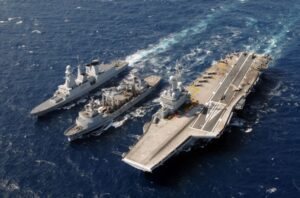 Charles de Gaulle
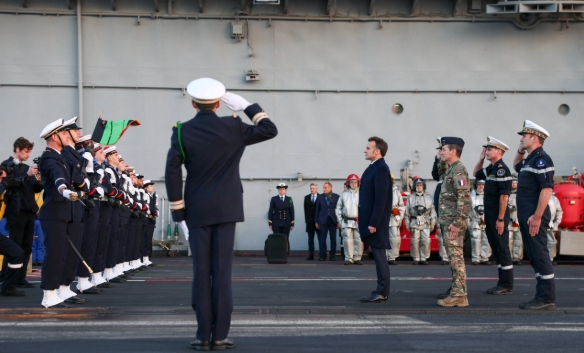
French President Emmanuel Macron said that French naval vessels would help protect trade routes through the Strait of Hormuz once they reopen.
Iran had earlier shut down the key shipping lane, disrupting oil flows and pushing global energy prices sharply higher.
There is no confirmed timeline for when European forces will deploy to the region. However, NATO sources suggest the operation could begin once the current phase of the conflict subsides.
Iran has meanwhile signaled that the conflict may continue for some time. Tehran has warned that it will keep attacking Gulf states in an effort to pressure them into mediating a ceasefire between Iran, the United States, and Israel.
Kamal Kharazi, a foreign policy adviser to Iran’s Supreme Leader, said the country was prepared for a prolonged war with the United States.
In an interview with CNN, he said Iran would continue attacks on Gulf countries to compel them to persuade US President Donald Trump to halt the military campaign.
According to Kharazi, the strategy aims to increase economic pressure across the region.
“This war has already produced significant economic pressure on others in terms of inflation and energy shortages,” he said, adding that the pressure would intensify if the conflict continued.
Tensions escalated after Iranian strikes on merchant ships and the closure of the Strait of Hormuz disrupted global energy trade. Around 20 percent of the world’s oil supply normally passes through the narrow maritime corridor.
Crude oil prices surged past $100 per barrel on Monday as maritime traffic through the strait stalled, forcing vessels to divert to longer routes or remain stranded.
Iran has also warned that its Middle Eastern neighbors including the United Arab Emirates, Kuwait, Qatar, Bahrain, Saudi Arabia, Iraq, and Syria would not be allowed to export oil while the war continues.
Attacks on oil and gas facilities in Qatar, along with strikes on tankers in the Arabian Gulf, have forced several countries to halt production as storage facilities reach capacity.
A spokesperson for Iran’s Islamic Revolutionary Guard Corps (IRGC) said that Iran was using about 60 percent of its military capability to target US bases and “strategic interests” in the region.
Meanwhile, Mojtaba Khamenei, the second son of former Supreme Leader Ali Khamenei who recently assumed Iran’s top leadership role, vowed to block all Gulf oil exports until US and Israeli airstrikes cease.
He said not “one liter of oil” would leave the Gulf while the bombardment continues.
The United Arab Emirates also shut down its largest refinery following a drone attack.
It was reported on Tuesday that the region’s largest single-site refinery in Ruwais, UAE, was closed as a precaution after a drone strike on the industrial complex.
Oil prices have climbed further following strikes on oil depots in Iran and attacks on energy infrastructure in Saudi Arabia, Bahrain, and other Gulf states. Explosions were also reported in Doha on Tuesday.
Qatar said Iranian attacks on civilian infrastructure were continuing, adding that the suspension of its liquefied natural gas (LNG) exports had already pushed European energy prices sharply higher.
In response, US and Israeli forces have intensified missile and air strikes inside Iran.
“Today will be yet another intense day of strikes inside Iran,” US Defense Secretary Pete Hegseth told reporters at the Pentagon.
The worsening conflict has sent shockwaves through global markets, prompting some governments to tap strategic petroleum reserves to cushion the impact on domestic economies.
In Nigeria, where there are no emergency relief measures, petrol prices have surged sharply from about ₦739 per litre in December to nearly ₦1,500 per litre despite the country producing both crude oil and refined products locally.
Egypt has also raised fuel prices by as much as 30 percent.
Pakistan has announced plans to provide naval escorts for commercial shipping, while France has already dispatched warships to the region.
President Trump warned that if Iran interferes further with oil exports, the US military would respond with overwhelming force.
“Death, fire, and fury will reign upon them; but I hope and pray that it does not happen,” Trump wrote on Truth Social.
Israeli Prime Minister Benjamin Netanyahu also vowed that Israel’s military campaign would continue.
“The Israeli Air Force is breaking their bones, and we are not done yet,” Netanyahu said.


