Skip to content

The Battle for the Skies: Iran’s missile stockpiles vs America’s air superiority

Sopuruchi Onwuka, with agency reports
When one of its terror cells, HAMAS, activated the infamous October 7 attacks against Israel, Iran was counting on its stockpiles of missiles and large network of footmen spread across the Middle East as it plotted execution of its regime’s key agenda: extermination of Israel possibly with a nuclear bomb.

Oracle Intelligence reports that in the past three years before and during the devastating Gaza war, Israel and the United States have been working on how the dismantle the engine of global networks of terrorism. Removing the Iranian regime that holds down its owns citizens, plunders oil wealth and feeds cash to global terror proxies seems to be best way of achieving peace for Israel and averting potential threat of nuclear attacks on the US.
But resolving contentious issues with Iranian regime proved difficult, so use of force became an option. Then the war that sparked off last Saturday came with coordinated strikes by two friends taunted by a common enemy.
As the conflict between the United States and Israel on the one hand, and Iran on the other hand enters its sixth day, attention has shifted from the initial shock of coordinated strikes to the resilience and capacity of the sides to endure a long-drawn war.
The war follows years of escalating confrontation across the region. After the October 7 attacks carried out by Hamas against Israel, regional tensions hardened further. Since then, Washington and Jerusalem have intensified efforts aimed at weakening Iran’s regional military network and missile capabilities.
Iran’s leadership has long relied on a combination of ballistic missiles, drone warfare, and allied armed groups across the Middle East as part of its deterrence strategy. Western governments argue that this network fuels instability. Tehran maintains it is essential for national defense.
Reza Talaiyenik, spokesperson for Iran’s Defense Ministry, said on the 3rd that the country retains the capacity to sustain what he described as an “offensive defense” longer than its adversaries expect. He added that Iran has not yet deployed all of its advanced weapons systems.
The statement directly countered earlier remarks by US President Donald Trump, who claimed Iran’s navy, air force, and much of its missile capability had been neutralized.
Independent analysts caution against assuming either side’s public statements fully reflect battlefield realities. While Iran has faced years of sanctions, it has invested heavily in asymmetric warfare capabilities designed to offset conventional disadvantages.
A January report by the Hudson Institute estimated that Iran used approximately 500 of its roughly 3,000 short- and medium-range ballistic missiles during a 12-day confrontation with Israel last year. Subsequent assessments suggested Iran worked to rebuild its stockpile, reportedly importing missile fuel components from countries including China.
US defense officials now estimate Iran possesses more than 2,000 operational medium-range ballistic missiles.
Among the most closely watched systems is the Fattah hypersonic missile series. Iranian officials describe it as capable of speeds between Mach 13 and 15, with maneuverability designed to complicate interception. During strikes in June 2024, Iran said it deployed the Fattah-1 against Israeli targets, including areas near Tel Aviv. Some warheads reportedly penetrated layered air defenses, though independent verification remains limited.
Iran’s arsenal also includes the Shahab-3 and Qodr medium-range ballistic missiles, each with a range of roughly 2,000 kilometers, placing not only Israel but parts of the Gulf region and Türkiye within reach. The Sumar cruise missile, with a reported range exceeding 2,500 kilometers, flies at low altitude, making detection more difficult.
Drones remain another key element of Iran’s strategy. The Shahed loitering munition series, widely observed in the war in Ukraine, is significantly cheaper than the interceptor missiles required to stop it. Analysts frequently cite the cost imbalance: a drone costing tens of thousand dollars can force the launch of interceptor systems worth millions.
Advanced weapons and air superiority
Oracle Intelligence reports that since the conflict escalated late last month, US forces have focused heavily on Iran’s missile production and launch infrastructure. Early operations featured the stealth B-2 Spirit bomber, which conducted long-range missions from Whiteman Air Force Base. Supported by aerial refueling, the aircraft targeted hardened underground facilities and air defense networks with precision-guided munitions.
 B-2 Spirit heavy ordinance bomber
The objective was to degrade Iran’s integrated air defense systems and open corridors for follow-on strikes.
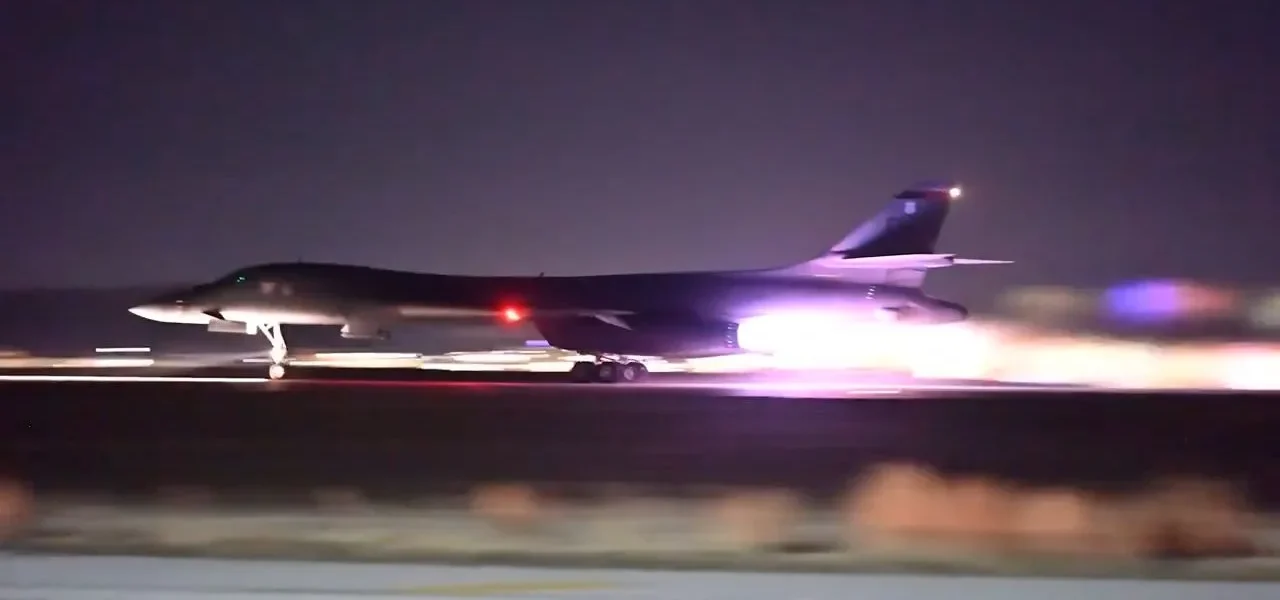
That next phase appears to involve the supersonic B-1 Lancer. US Central Command confirmed that B-1 bombers conducted nighttime strikes deep inside Iranian territory, targeting ballistic missile bases and command-and-control facilities. Video released by US forces showed aircraft taking off under darkness ahead of the mission.
Flight tracking reported by The Times of Israel indicated that multiple B-1 aircraft departed from Ellsworth Air Force Base in South Dakota before carrying out strikes.
Unlike the B-2, the B-1 does not rely primarily on stealth. Instead, it combines speed, payload capacity, and low-altitude penetration tactics. With variable-sweep wings and four afterburning turbofan engines, it can carry up to 34 tons of conventional ordnance. Its operational doctrine emphasizes rapid entry and exit, supported by terrain-following radar systems.
Military analysts note that the deployment of the B-1 may indicate that earlier suppression efforts were at least partially successful. Stealth platforms typically lead operations in heavily defended airspace. The introduction of non-stealth bombers suggests that key radar and missile systems may have been degraded.
US Defense Secretary Pete Hegseth stated that operations remain in early stages, with additional troops and firepower arriving in the region. President Trump has asserted that US weapons supply capacity remains effectively unlimited.
Reports from foreign media outlets suggest that within the first 48 hours of the campaign, US and Israeli forces may have struck between 1,000 and 2,000 military-related sites across Iran. These figures have not been independently verified.
What remains uncertain is the rate at which both sides are depleting high-value assets. Iran’s missile inventory, drone stockpiles, and underground infrastructure were designed with endurance in mind. The United States and Israel, meanwhile, rely on technological superiority, precision strikes, and sustained logistics.
The strategic calculation now centers on durability. If Iran’s air defenses continue to erode, aerial operations may expand further. If missile reserves remain substantial, retaliatory strikes could persist.
In modern warfare, dominance is not measured only by firepower but by sustainability. The coming weeks will likely reveal whether the campaign represents a decisive turning point or the beginning of a longer and more grinding confrontation.