Skip to content

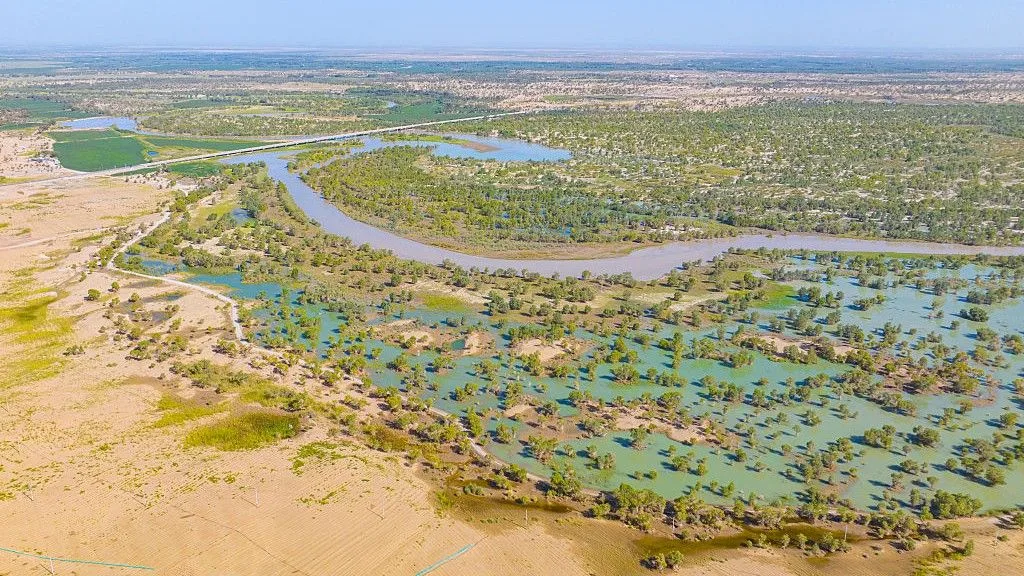
China turns Taklamakan Desert from ‘biological void’ into a carbon sink

China’s decades-long tree planting campaign is beginning to reshape the environmental profile of the Taklamakan Desert, with new research suggesting that parts of the once barren landscape are now functioning as a carbon sink.
Covering roughly 130,000 square miles in China’s Xinjiang region, the Taklamakan is one of the world’s largest and driest deserts.

Ringed by high mountain ranges that block moist air for most of the year, more than 95 percent of its surface is shifting sand. For decades it was considered a “biological void,” with conditions too harsh to support sustained vegetation.
That began to change in 1978, when China launched the Three-North Shelterbelt Program, better known as the “Great Green Wall.” The massive ecological engineering effort aims to slow desertification by planting billions of trees across northern China, particularly along the edges of the Taklamakan and Gobi deserts, by 2050.
To date, more than 66 billion trees have been planted. In 2024, China completed a vegetation belt encircling the Taklamakan, stabilizing sand dunes and contributing to an increase in national forest cover from about 10 percent in 1949 to more than 25 percent today.
A new study published Jan. 19 in the journal Proceedings of the National Academy of Sciences (PNAS) finds that vegetation along the desert’s rim is now absorbing more carbon dioxide than the desert emits.
Researchers analyzed 25 years of ground observations and satellite data, examining precipitation, vegetation cover, photosynthesis rates and carbon fluxes. They also used modeling tools from the National Oceanic and Atmospheric Administration to track carbon sources and sinks.
The results show a steady expansion of vegetation around the desert’s periphery, closely aligned in both time and location with the Great Green Wall project.
During the wet season from July to September, average precipitation reaches about 0.6 inches per month, roughly 2.5 times higher than in the dry season. The additional rainfall boosts plant growth and photosynthesis, reducing atmospheric CO2 concentrations over the desert from around 416 parts per million in the dry season to about 413 ppm in the wet season.
Earlier research had suggested that the Taklamakan might act as a carbon sink because desert sands can absorb CO2.
However, scientists warned that this storage is unstable under rising temperatures, which can cause trapped gases to be released.
The new findings point instead to vegetation-driven carbon sequestration, which is considered more stable, at least along the desert’s margins.
While the core of the Taklamakan remains overwhelmingly arid, its edges now offer what researchers describe as the first large-scale example of human intervention turning part of an extreme desert environment into a functioning carbon sink.
The long-term stability of that shift will depend on rainfall patterns, water availability and how the region responds to climate change.