Skip to content


WIEN engages presidency, pledges contribution to energy goals

* As activists demand reserved seats for women in politics
Sopuruchi Onwuka

Africa’s most effective gender equity and capacity development advocate, Women in Energy Network (WIEN), has restated its resolve to assist the federal government position Nigeria as a global model for gender equity, inclusive growth, and sustainable development.
In a presentation to the Special Adviser to the President on Energy, Mrs Olu Verheijen, WIEN stressed the need for a partnership that makes inclusion not just a pledge but a measurable reality with national impact.
The group led by Mrs Eyono Fatai-Williams was hosted to a strategic meeting by Mrs Verheijen in Abuja to work out collaboration in delivering government’s broad economic aspiration in the petroleum industry.
The meeting with WIEN comes at time the government is driving the petroleum industry to rise to the prevailing need to meet multiple aspirations of satisfying internal demand for crude oil by local refiners, boosting the country’s foreign exchange earnings to buoy the Naira at the forex market, diversifying energy sources and also driving increased use of natural gas for sundry energy applications.
WIEN has consistently maintained that the country needs the full capacity of its talents and human resources, irrespective of gender, in tackling the myriad of issues that hinge on energy sufficiency, availability and affordability.
In the meeting with the Presidential Adviser, WIEN declared that the contribution of its corporate and individual members as well as affiliate companies offers immense benefits to the government by leveraging its extensive network of industry leaders, corporate members, financiers, and development partners to align public and private sector resources with government priorities.
Mrs Fatai-Williams who led the delegation to Mrs Olu Verheijen stated that collaboration with WIEN would unlock public-private alliance and mobilize investment for capacity-building programs. The full value import, according to her, would ultimately reduce fiscal burden on government.
For the group and its allied companies and professionals to unleash full potentials in delivering government’s agenda in the energy industry, WIEN proposed that government adopts Supplier Diversity in Contracting and Bidding in the energy industry. It said the measure is to reserve at least 35% of eligible contracts for women-owned businesses where capacity exists. And in the areas where capacity gaps exist, WIEN suggested that government mandates “capacity-building and mentorship pathways so women-owned firms can scale and compete sustainably.”
It also called on government to drive the Renewed Hope Agenda towards guaranteeing 35% women positions on boards and in senior management across the energy sector. WIEN demanded that enforcement of gender diversity in industry leadership positions should come with clear compliance guidelines and timelines for public and private operators to either “comply-or-explain.”
Mrs Fatai-Williams also proposed establishment of a policy-backed partnership with WIEN for training, mentorship, scholarships, internships, and leadership development.
She stated that the Capacity Building & Pipeline Development programme with a STEM focus should be nurtured into a STEM-to-Leadership pipeline: from girls in classrooms to technical roles and future board seats.
To effectively drive diversity, equity and inclusion (DEI) Standards, Compliance & Accountability; Mrs Fatai-Williams offered WIEN to be designated government’s benchmark partner on setting standards and tracking compliance across the energy sector. She also stressed the need to maintain a pool of competent, trained women for board and senior management recommendations, ensuring readiness and availability of talent.
WIEN also demanded government to drive DEI compliance in the sector “through independent reviews, transparent reporting, and incentives/penalties linked to licensing and participation in the energy vendor supply chain.”
By adopting WIEN’s 3-point gender inclusion agenda through Executive Action, Mrs Fatai-Williams noted, the government would deliver on Renewed Hope Agenda pledges by fast-tracking the 35% women inclusion target in procurement, leadership, and STEM.
The strategy, she pointed out, would strengthen Nigeria’s competitiveness by building a deeper, more diverse talent pool and reducing reliance on expatriates. She added that the three point agenda would also unlock economic growth, noting that most women-owned businesses reinvest up to 90% of earnings into families and communities, directly multiplying the socio-economic impact of the policy action.
WIEN stressed that diverse boards and leadership drive stronger oversight and decision-making. It added that balanced decision making would enhance governance and accountability in the industry; boost Nigeria’s international reputation and investment appeal; position the country as a regional leader in gender equity; and align the industry with ESG and SDG commitments that attract global investors.
Other benefits of WIEN’s proposed measures, according to Mrs Fatai-Williams, include mobilizing resources beyond government; noting that WIEN’s networks bring private sector, development partners, and financiers to co-fund capacity-building. She stated that the strategy would eases fiscal pressure on the state.
WIEN urged government to integrate the measures into the Renewed Hope Agenda to unlock the full potential of women in energy; strengthen competitiveness, attract investment, and enhance governance through supplier diversity and inclusive leadership. It also demanded government to track DEI compliance in the sector, and ensure measurable accountability in the industry by deploying the group’s pool of competent women.
Other benefits the collaboration would bring on board, WIEN stated, is to use the group’s programmes to amplify government’s initiatives through campaigns, events, and international platforms; showcasing Nigeria as a leader in gender equity and inclusive growth.
More benefits to government, the group proposed, include enhancing Nigeria’s global reputation, supporting attraction of foreign direct investments, and demonstrating alignment with international sustainability and ESG commitments.
Founded with the vision of fostering the advancement of women in the energy sector, WIEN has consistently contended that a diverse and inclusive industry is not just a moral imperative, but a strategic necessity for the sustainable growth of any industry.
“WIEN therefore seeks greater representation of women in career, on boards and in leadership roles throughout the energy sector by advocating equal opportunities for women compared to their male counterparts in the industry.” the group stated in a presentation.
With about 2,200 hours of active learning delivered by way of masterclasses, power meetings and health talks, the group boats that it has deployed immense resources in building the capacity of its members and providing the requisite experience and competency support base to ensure that its members in industry leadership positions excel.
“We urge all stakeholders in the energy sector to collaborate with us in supporting and sponsoring young girls pursuing STEM education at higher institutions and various training institutes. Additionally, we encourage these companies to assist in crafting career paths and offering internship and mentorship programs to these young girls within their organizations.
“We advocate for fostering vendor diversification for women in business and the allocation of more business opportunities to competent and capable women within the oil and gas sector,” Mrs Eyono Fatai-Williams told Mrs Olu Verheijen.
The Presidential Adviser, who happens to be the first female to occupy the strategic industry leadership position in the history of the country, pledged to collaborate with WIEN in realizing full potentials of the sector by harnessing all talents necessary to deliver the country’s goals in the energy industry.
She congratulated WIEN on its quality of offerings in the industry, noting that the group represents well respected corporate organizations, professionals and business leaders in the industry and also in the country.
She pledged government’s unwavering commitment in partnering the group to realize its agenda for equitable inclusion in the leadership of the industry.
Oracle Intelligence reports that WIEN is not alone in decrying the marginalization of women in the nation’s governance systems. Whereas WIEN is committed to gender balance in the energy sector, other groups are active with campaigns for gender balance in political representation in the country.
At the time WIEN engaged the Presidential Adviser on Energy, hundreds of women and youths protested on the Abuja roads to push for a bill that would reserve women-only seats in the Senate and House of Representatives. The protesters demand more female representation in politics through the Reserved Seats for Women Bill.
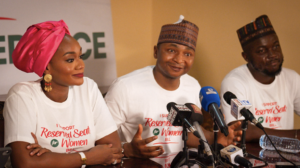
The bill, if passed, would create 182 seats for women in parliament, aiming to ensure fairer, more inclusive governance and address Nigeria’s low ranking in women’s political empowerment.
Despite constituting some 50 percent of the population and over 60 percent of active voters, women hold less than 5 percent of political positions in the country, especially in the federal and state legislatures. And over 10 states of the country’s 36 states do not have female law makers at all.
Oracle Intelligence reports that Nigeria has one of the lowest numbers of female representation in politics worldwide. World Economic Forum (WEF) ranks the country as one of the worst in women political empowerment. And Reserved Seats for Women Bill when passed into law is expected to bring greater inclusion in governance. An earlier bill seeking more seats for women was rejected by the National Assembly in 2022.
Reserved Seats for Women campaign leader, Osasu Igbinedion Ogwuche, stated during the march in Abuja that the barriers faced by women in taking seat in politics are structural, financial, religious and cultural.
“So, when women who have capacity come out to vie, they are usually sidelined because of these barriers. We are therefore canvassing for women to have reserved seats so that they have a level playing field to compete with other women,” she said.
Gender activist, Ene Obi, stated during the march in Abuja that women are struggling to correct the imbalance in the country’s political representation and enthrone diversity in the nation’s governance systems.
She made it clear that women are not staging competition with men in the country, adding that balance entails that men, women and youths are given fair and equitable opportunity to participate in the nation’s political process.
Faith Waziri, a female activist, also pointed out that girls in the country suffer double jeopardy because “they are first marginalized as youths and also marginalized as women.”