Skip to content


- 125 Bbbls liquids, 620tcf Gas yet to be prodcued
- Over 600m citizens live without access to electricity
The scale of energy poverty facing the African continent calls for more than $200 billion annual investments in energy infrastructure and facilities required to strengthen energy access, resilience and petroleum development.
Worse still, about 600 million Africans remain without electricity on a continent of more than 1.6 billion young people, calling for parallel investments in converting resource to energy.

Despite holding more than 125 billion barrels of proven crude oil reserves and over 620 trillion cubic feet of proven natural gas reserves, or about 9 per cent of global proven oil reserves and 8 per cent of global proven gas reserves, Africa attracts only about 6 per cent of global exploration spending and upstream capital.
Thus, Africa is facing a deepening energy paradox in which enormous reserves of oil and natural gas coexist with acute energy poverty, weak infrastructure and inadequate investment, creating both a major development challenge and one of the continent’s largest investment opportunities.
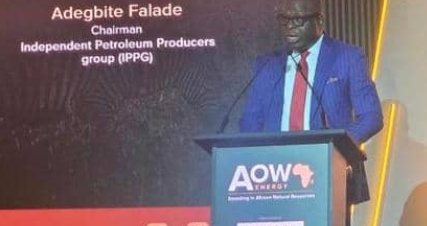
According to the Chairman of the Independent Petroleum Producers Group (IPPG), Adegbite Falade, the situation calls for more than $200 billion in annual energy investment by 2030 to build the infrastructure and facilities needed to improve energy access, strengthen resilience and support petroleum exploration, development and production,.
Falade, who spoke on Africa’s Upstream Outlook: Setting the Strategic Tone at the opening ceremony of AOW: Energy 2026 in Accra, Ghana, said the scale of the investment requirement underscored the widening gap between Africa’s enormous resource endowment and its capacity to convert those resources into affordable and reliable energy.
The contradiction is particularly striking on a continent of more than 1.6 billion people, where about 600 million people lack access to electricity.
According to Falade, Africa possesses more than 125 billion barrels of proven crude oil reserves and over 620 trillion cubic feet of proven natural gas reserves, representing approximately nine per cent of global proven oil reserves and eight per cent of global proven gas reserves.
Yet, despite this substantial resource base, Africa attracts only about six per cent of global exploration spending and upstream capital, revealing the extent to which inadequate investment is preventing the continent from fully exploiting its petroleum potential.
“Africa remains simultaneously the world’s most energy-endowed and most energy-poor continent,” Falade said.
The resource paradox is also reflected in the continent’s petroleum trade. Africa produces approximately eight million barrels of crude oil per day, but refines barely half of that volume. As a result, countries across the continent collectively spend more than $60 billion annually on refined fuel imports, even while sitting on vast crude oil reserves.
The situation demonstrates that Africa’s problem is not simply a lack of natural resources but a shortage of investment across the petroleum value chain. Crude production must be supported by gathering systems, pipelines, storage facilities, refineries, petrochemical plants, transportation infrastructure and reliable power systems if resource wealth is to translate into broader economic development.
The gas sector presents an equally striking contradiction. Africa produced approximately 262 billion cubic metres of natural gas in 2025, while domestic consumption was only about 185 billion cubic metres. At the same time, millions of Africans continued to face inadequate energy supplies.
Falade argued that the figures point to an urgent need to invest beyond upstream production into gas processing, transmission and distribution infrastructure capable of connecting resources with consumers and industries.
“Reserves without pipelines are simply stranded molecules benefiting no one,” he said, stressing that investment in upstream production must be matched by investment in midstream infrastructure.
The infrastructure deficit is particularly pronounced in the gas industry, where natural gas already accounts for about 40 per cent of Africa’s electricity generation. Despite this contribution, the continent has less than 50,000 kilometres of gas pipeline infrastructure, compared with more than 200,000 kilometres of interconnected oil and gas trunk pipelines in Europe.
For Falade, the disparity demonstrates the scale of infrastructure investment required to transform Africa’s gas reserves into productive economic assets. He called for investment in pipelines, gas-processing facilities, power grids and export infrastructure.
The consequences extend beyond energy supply. Inadequate petroleum infrastructure limits industrialisation, constrains manufacturing and leaves countries dependent on expensive imported energy products despite their own resource wealth.
The investment opportunity is also being reshaped by the growing role of indigenous African operators. Falade cited Nigeria as evidence that local companies are increasingly capable of developing assets previously operated by international oil companies.
He said Nigerian indigenous companies, which accounted for less than three per cent of national oil and gas production just over three decades ago, now contribute more than half of the country’s crude oil and gas output, following the divestment of several onshore and shallow-water assets by international oil companies.
According to him, just three indigenous operators added about 200,000 barrels of oil per day to Nigeria’s national production over the past year.
Falade said the development demonstrated that indigenous companies could revive mature and previously underperforming assets through technical competence, capital deployment and faster decision-making. He consequently urged international investors to regard the changing ownership structure as an opportunity to establish new partnerships rather than as evidence of Africa’s declining investment attractiveness.
“The divestment era is not an exit. It is an invitation to a new kind of partnership — technology, capital and capability alongside local ownership and local urgency,” he said.
The financing challenge, however, remains considerable. The Africa Energy Bank, established through a partnership between the African Petroleum Producers Organisation and Afreximbank, has an initial capital base of $5 billion, with plans to mobilise up to $10 billion in its first phase and grow towards $15 billion by 2030.
Falade described the bank as a potentially important mechanism for bridging the financing gap created by the retreat of some traditional international financiers from African oil and gas projects. But he stressed that African producers would still need to develop commercially viable and bankable projects capable of attracting both domestic and international capital.
The fragmentation of African energy markets adds another layer to the challenge. Falade urged investors to look beyond individual national markets and take advantage of deeper regional integration under the African Continental Free Trade Area.
He cited the West African Gas Pipeline, which has transported Nigerian gas to Benin, Togo and Ghana for 15 years, as evidence that cross-border energy infrastructure can connect resource-rich countries with energy-deficient markets.
He proposed a dedicated AfCFTA Energy Services Protocol to facilitate intra-African hydrocarbon trade and cross-border pipelines and infrastructure, alongside a Pan-African Technical Exchange Programme to accelerate the movement of technical skills across producing countries.
Such integration, he argued, could expand regional markets for gas-to-power, refining, petrochemicals and energy services, creating the scale required to make major infrastructure projects more commercially viable.
Africa’s investment deficit also extends to renewable energy. Despite possessing some of the world’s richest solar, hydro, geothermal and wind resources, the continent attracted only about two per cent of global clean-energy investment last year.
Installed renewable capacity increased from approximately 33GW in 2014 to 82GW in 2025, but Falade said Africa continues to exploit only a fraction of its renewable potential. He therefore advocated an energy strategy based on diversification, rather than replacing hydrocarbons with renewables before adequate energy access has been achieved.
The urgency is heightened by the retreat of international capital from African oil and gas projects. Falade cited industry estimates indicating that more than 150 energy projects across the continent have been stalled, partly reflecting the difficulty of securing long-term financing amid global decarbonisation policies.
He argued that Africa’s circumstances require an energy strategy tailored to its developmental realities, particularly because the continent accounts for less than three per cent of global greenhouse gas emissions while possessing substantial oil, gas and renewable resources.
“Africa’s energy must first power Africa,” Falade said, advocating greater investment in gas-to-power, gas-to-fertiliser, gas-to-industry, refining, petrochemicals, LPG for clean cooking and reliable electricity for manufacturing.
The figures collectively point to a resource paradox that cannot be resolved through increased oil and gas production alone. Africa needs investment across the entire petroleum ecosystem, from exploration and production to pipelines, processing, refining, power generation and transmission, while simultaneously expanding renewable energy capacity.
With 125 billion barrels of proven oil reserves, 620 trillion cubic feet of gas, eight million barrels of daily crude production, $60 billion in annual refined-fuel imports, less than 50,000 kilometres of gas pipelines and 600 million people without electricity, the scale of the infrastructure and investment deficit is evident.
Falade therefore called for governments to provide fiscal stability, faster permits and contract sanctity, while urging financiers and insurers to assess African investment risks on the basis of operational evidence rather than prevailing narratives.
The central challenge, he said, is to create a new investment model in which international capital, technology and expertise work with increasingly capable African companies to unlock the continent’s resources and ensure that those resources are ultimately converted into electricity, industrial feedstock, refined products, jobs and broader economic growth.