Skip to content

Brazen audacity: How US forces rescued trapped bomber crew in Iran

Sopuruchi Onwuka
Sophisticated military technology, tightly coordinated communication systems, disciplined equipment handling and calculated risk defined the U.S. effort to recover two airmen who ejected into hostile territory during ongoing strikes near Tehran.
In modern conflict, such missions highlight a shift away from brute force toward integrated operations, where success depends on timing, coordination and the ability to manage uncertainty in real time.
 A Hercules C-130 place leads helicopters in rescue mission into enemy territory in Iran
What unfolded over the next two days was less a single act of heroism and more a layered operation that brought together intelligence assets, air power and special operations forces under sustained pressure.
The incident began when an F-15E Strike Eagle was hit by missile fire while carrying out its mission. Both the pilot and the weapons systems officer ejected in the early hours, landing in rugged terrain that immediately complicated recovery efforts.
Within minutes, U.S. rescue units were activated, triggering a search operation that would stretch across nearly two days and test the limits of coordination in hostile airspace and land terrains.
While one crew member was located and extracted within hours, the second airman remained isolated deep behind enemy lines. Injured and lightly armed, he relied on survival training to move away from the crash site and into higher ground, eventually reaching an elevated position where he could activate an emergency beacon and remain concealed.
Iranian forces were quickly made aware of his presence and offered a $60,000 reward for his capture, leading Basij militia to advance on the mountain roads below.
 Iranian bounty hunters comb crash site in search of crew members after they were promised $60,000 by the Islamic regime
Injured after ejecting from an F-15 fighter jet which had been gunned down over Iran, stuck in a treacherous mountain range deep behind enemy lines and armed with just a handgun for protection, the situation could hardly have been bleaker for the stricken colonel.
But the injured brave colonel, trained to evade capture and survive under severe conditions, had trekked 70 miles and climbed to 7,000 feet where he activated his emergency beacon and lay low for nearly two days.
His ability to evade detection for an extended period proved critical, buying time for a rescue effort that was still taking shape.
As intelligence units worked to pinpoint his exact location, efforts were made to disrupt opposing forces on the ground. Elements linked to the Islamic Revolutionary Guard Corps began moving into the area, supported by local militia responding to calls for the pilot’s capture.
In response, U.S. aircraft were deployed to contain the situation, with platforms such as the A-10 Thunderbolt II targeting access routes, communications infrastructure and approaching vehicles in an attempt to slow the advance.
At the same time, U.S. intelligence operations sought to create confusion, circulating misleading signals about the airman’s status in order to buy additional time. Meanwhile, the CIA confused the Iranians, spreading word that the colonel had already been located and buying themselves time to locate the airman.
This blend of battlefield shaping and information control allowed planners to prepare a more deliberate rescue attempt rather than rush into a high-risk extraction under full enemy pressure.
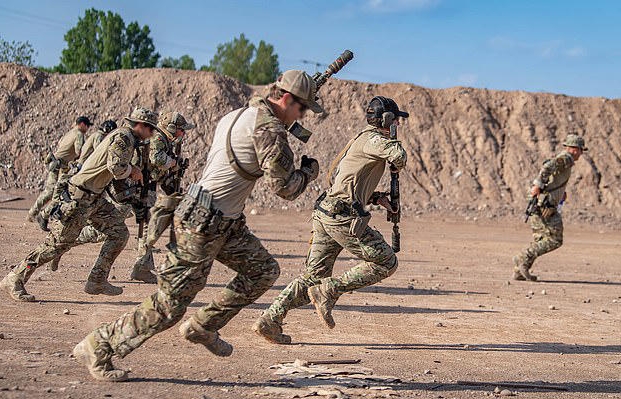
The insertion of rescue forces marked the most delicate phase of the mission. Special operations units were deployed into the area using a mix of aircraft, including the C-130 Hercules and helicopters such as the UH-60 Black Hawk. Flying low and navigating difficult terrain, crews faced both environmental hazards and active resistance.
Some aircraft sustained damage during earlier attempts, underscoring the risks involved in operating deep inside contested territory.
As ground teams moved toward the airman’s position, they encountered resistance from advancing fighters, leading to a brief but intense firefight.
The outcome hinged on coordination. Air support suppressed movement on key routes while ground units advanced with precision, maintaining communication links that allowed them to adapt quickly to changing conditions.
Complications arose when some transport aircraft became stranded during the operation, forcing U.S. forces to make a rapid decision to destroy sensitive equipment rather than risk it falling into hostile hands. The destruction of these assets, while costly, reflected standard military protocol in denied environments where recovery is no longer possible.
Despite these setbacks, the rescue team succeeded in reaching the isolated airman, securing him and moving quickly to an extraction point. Under continued cover from aircraft overhead, the remaining rescue platforms exited the area, completing the mission just before conditions could shift further in favor of opposing forces.
Throughout the operation, senior leadership, including Donald Trump, monitored developments closely, reinforcing the long-standing U.S. military position that personnel recovery remains a priority regardless of the risks involved.
Public statements following the mission framed it as a demonstration of capability and resolve, though details surrounding casualties and damage remain contested between both sides.
What stands out in the operation is not a single moment, but the interplay of systems and decisions. The airman’s ability to survive and remain undetected, the use of air power to shape the battlefield, the precision of special operations forces and the willingness to sacrifice equipment to protect sensitive technology all contributed to the outcome.
Oracle Intelligence which reviewed the developing stories on the intricate mission reports that the world watched in awe as both the fugitive, the American intelligence network inside Iran, the US Central Command in the Middle East, the Pentagon and White House collaborated in investing every available facility in extracting one man from the grips of the enemy.
President Trump who spent his holiday across the weekend to supervise the audacious extraction the US airman under hot exchange of fire with Iranian forces declared the commitment of the United States government to put everything on the line to rescue a trapped fighter.
He branded the mission a huge success, saying it proved the Americans’ ‘dominance and superiority’ over the Iranian skies.