Skip to content


Uk, Nigeria sign landmark £746 million ports deal

Sopuruchi Onwuka
The United Kingdom and Nigeria have signed a landmark £746 million ports redevelopment deal, marking one of the largest recent trade and investment partnerships between the two countries and signalling a major push to modernize Nigeria’s maritime infrastructure while supporting jobs and industry in both economies.
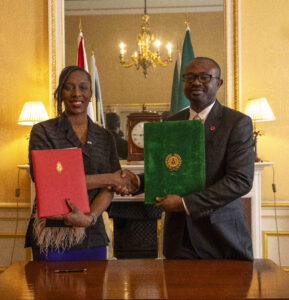
The agreement, backed by UK Export Finance, will fund the refurbishment of two of Nigeria’s busiest ports in Lagos, the Lagos Port Complex and the Tin Can Island Port Complex. Financing will be delivered through UKEF’s Buyer Credit Facility, arranged by Citibank (London branch), enabling Nigeria to access funding while ensuring British exporters are paid.
The deal, signed on Thursday 19 March, is expected to support thousands of skilled jobs across both countries and channel hundreds of millions of pounds into their economies. At least £236 million of the total contract value will go to British companies, underlining strong supply chain participation from the UK.
A key component of the agreement is a record £70 million export contract awarded to British Steel, which will supply 120,000 tonnes of steel billets for the project. The materials will be used by construction firms Hitech Nigeria and ITB Nigeria, both of which have played leading roles in major infrastructure developments across the country. The contract represents British Steel’s largest export order backed by UKEF and aligns with the UK government’s broader Steel Strategy aimed at revitalising the domestic steel sector.
UK Business and Trade Secretary Peter Kyle described the agreement as a significant win for British manufacturing, noting that it reflects both the quality of UK-produced steel and the growing strength of UK-Nigeria economic ties. He said the deal would support jobs and growth in key industrial areas such as Scunthorpe while reinforcing the global competitiveness of British industry.
On the Nigerian side, Minister of Marine and Blue Economy Adegboyega Oyetola said the project represents a major step forward in unlocking the country’s maritime potential. He explained that modernising port infrastructure will improve efficiency, reduce cargo delays and lower logistics costs for businesses by replacing manual processes with digital and automated systems. According to him, the upgrades are expected to significantly cut vessel turnaround times and cargo dwell periods, while improving transparency and boosting revenue generation.
In addition to the financing agreement, both countries signed a new Memorandum of Understanding outlining plans to deepen cooperation in trade, investment and industrial development. The framework identifies a pipeline of priority Nigerian projects that could benefit from future UKEF support, while also creating further opportunities for UK companies to participate in large-scale infrastructure delivery.
Executives involved in the transaction highlighted its broader economic significance. Richard Hodder of Citi noted that the bank, which has operated in Nigeria for over 40 years, played a coordinating role in delivering one of the largest export credit-backed financing deals in West Africa. He said the project would generate long-term economic benefits for Nigeria by strengthening critical infrastructure.
Similarly, Tim Reid said the agreement demonstrates UKEF’s ability to unlock major international opportunities for British businesses while supporting sustainable growth in emerging markets. He noted that with over £200 million flowing back to UK suppliers, the deal lays the groundwork for a deeper and more sustained economic partnership between the two countries.
The project also reflects UKEF’s expanding footprint in West and Central Africa, where it has provided more than £3 billion in support since 2018. In the 2024/2025 financial year alone, the agency delivered a record £14.5 billion in new financing, supporting over 667 UK companies and up to 70,000 jobs.
Structured as a Buyer Credit facility, the deal allows Nigeria to borrow from commercial lenders to pay UK exporters, with UKEF acting as guarantor rather than providing direct funding. The arrangement reduces financing risk while enabling large-scale infrastructure projects to proceed.
Taken together, the agreement and accompanying Memorandum of Understanding send a strong signal to global markets that Nigeria is open for business, with both governments positioning the partnership as a foundation for long-term trade expansion, infrastructure development and economic growth.