Skip to content

UN demands government’s response to Nigeria’s worsening humanitarian crisis

Sopuruchi Onwuka
United Nation’s humanitarian office in Nigeria has stated that the current security crisis in the country is rapidly transcending regional and religious lines while spreading deadly conflicts across neighboring communities.

The UN is now urging Nigerian federal and state authorities to take greater ownership of the response, even as it presses donors not to turn away; pointing at the country’s
stark paradox of being one of Africa’s largest economies confronting a humanitarian crisis more often associated with far poorer states.
A UN bulletin sent to Oracle Intelligence noted that violence has spread across much of the country, leaving millions displaced and fueling one of Africa’s largest and most overlooked humanitarian emergencies.
Un news portal reported on January 29 that the scale of violence shaking Nigeria extends beyond religious conflicts that earned the country few airstrikes on Christmas Day against Islamist militants in northern Nigeria.
The strikes thrust Nigeria’s long-running sectarian bloodshed into the global spotlight and validated claims that a “Christian genocide” is unfolding in Africa’s most populous country.
The report quoted UN resident and humanitarian coordinator, Mohamed Malik Fall, as saying that “Security remains one of Nigeria’s major challenges,” adding that violence is spreading across regions to “everywhere.”
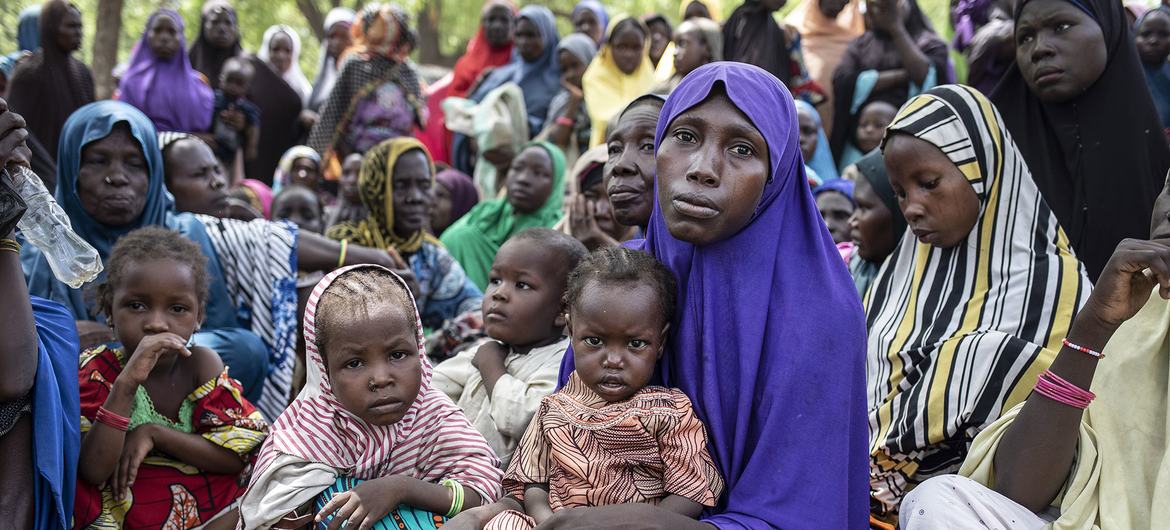
UN stated that more than two million people remain displaced in the northeast alone, many of them for years, quoting Mr Fall as saying that “an entire generation has grown up in displacement camps, knowing nothing else.”
Beyond deeper damages to social and economic cohesion in the country, Mr Fall lamented that the human toll remains extensive with more than 40,000 people killed since the start of the insurgency, thousands of schools and health centers destroyed, and vast agricultural areas rendered inaccessible.
“People have been cut off from all economic activity,” he said. “They are deprived of the ability to live from their work and preserve their dignity.”
What was once a localized insurgency has morphed into something broader and more diffuse, the UN reported.
The agency noted that armed criminal groups locally called bandits have seized control of rural areas in Zamfara, Katsina and Sokoto, carrying out mass kidnappings and extortion.
Entire villages have been abandoned, and around one million people are now displaced in the region, according to United Nations estimates.
In the country’s central belt, clashes between farmers and herders over land, intensified by climate pressure and environmental degradation, have triggered further displacement.
“The cumulative result is a country with roughly 3.5 million internally displaced people – nearly 10 percent of all displacement across Africa,” the UN noted.
Recent attacks against churches and Christian schools have revived international attention when, in January, more than 160 worshippers were abducted during Sunday services in Kaduna State.
Days earlier, villages in the northwest were attacked, killing dozens, while students near a Catholic school in Papiri were again targeted.
The violence revived memories of the 2014 abduction of 276 schoolgirls from Chibok, most of them Christian, by Boko Haram – a moment that once galvanized global outrage.
Citing the need to protect Christians from Islamist militants, the US administration ordered airstrikes on Christmas Day against jihadist positions in northern Nigeria. In Washington, some officials have since argued that a “Christian genocide” is underway.
But Mr Fall, a Muslim, also noted that attacks on mosques that claimed many worshipers also happen in the country.
He pointed to an attack in Maiduguri, the historic centre of the insurgency, carried out on Christmas Eve in an area “between a mosque and a market,” which killed Muslim worshippers as they left prayers.
“Insecurity affects everyone, without distinction of religion or ethnicity,” he said, warning that oversimplified narratives risk deepening social fractures rather than addressing their causes.
Behind the violence lies a humanitarian emergency of enormous scale, the UN stated, counting that 7.2 million people need assistance in the northeastern states alone with nearly six million of them in severe or critical condition.
The UN also added that food insecurity has become the defining threat as aid agencies project that up to 36 million Nigerians could face varying levels of food insecurity in the coming months. And among children under five, more than 3.5 million are at risk of acute malnutrition.
Climate shocks, including droughts and floods, have compounded the crisis alongside recurring cholera and meningitis outbreaks and a fragile health system, the UN reported, warning that funding has collapsed despite the scale of the emergency.
“A few years ago, Nigeria’s humanitarian response plan raised close to $1 billion annually,” Mr. Fall said. “In 2024, it was $585 million. Last year, barely $262 million. This year, we are not even certain we will reach $200 million.”
The decline comes as donor attention has shifted to higher-profile crises elsewhere, including Ukraine and Sudan.
“Nigeria is not Sudan. It is not Somalia. It is not South Sudan,” Mr. Fall said. “This is a country with resources. The primary responsibility for responding to humanitarian needs lies with the government.”
“No one wants to live on aid,” Mr. Fall said. “People would rather be helped to access economic opportunities than remain dependent. Giving a fish is good. Teaching how to fish is better.”