Skip to content

Wars drive Africa’s economic strain, hunger and displacement, UN warns

Ziggy Ojiegbe
The United Nations has warned that escalating conflicts across parts of Africa and the Middle East are deepening economic hardship, fuelling hunger and driving mass displacement, with civilians bearing the heaviest burden.

UN Secretary-General António Guterres remains gravely alarmed by intensifying hostilities in northern Syria, particularly in Aleppo, where clashes between government forces and Kurdish groups have displaced tens of thousands of people in recent days, according to his spokesperson.
Briefing journalists in New York on Thursday, UN Spokesperson Stéphane Dujarric said fighting had intensified sharply, leading to civilian casualties and widespread destruction of critical infrastructure.
The UN Office for the Coordination of Humanitarian Affairs (OCHA) reported that at least five civilians, including two women and a child, were killed as of Wednesday, with dozens more injured. Several health facilities, including three hospitals, have been damaged or attacked, forcing some to shut down. Authorities have also imposed movement restrictions on key roads.
“Since yesterday morning, thousands of families have fled their homes, with many seeking shelter with host communities in Aleppo city and across districts of Afrin,” Dujarric said.
Local authorities have opened two humanitarian corridors to allow civilians to evacuate, while aid agencies are mobilising resources to respond to the growing displacement. A UN team has already conducted an assessment mission to Yad Al Aoun camp in Afrin to evaluate urgent needs and response capacity.
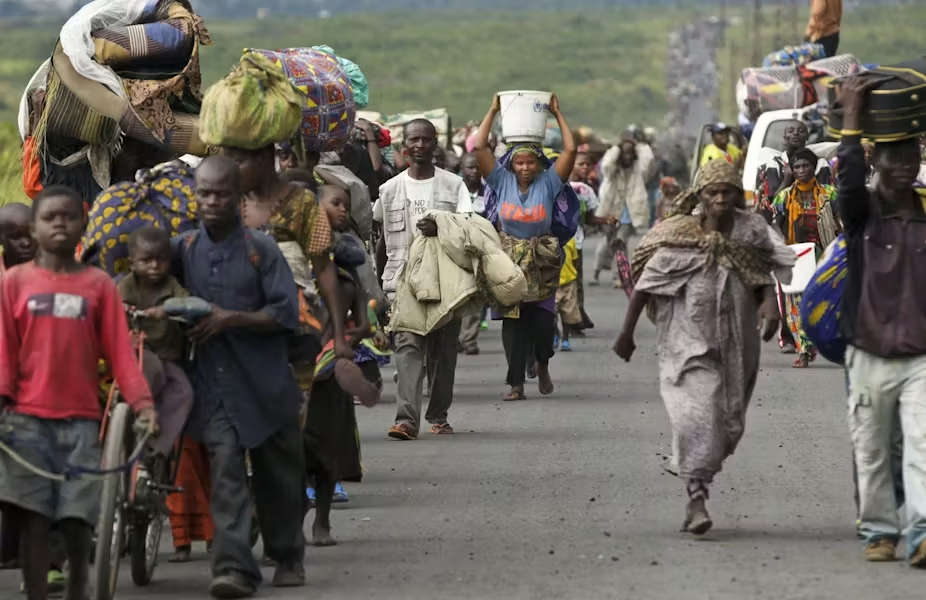
In Africa, renewed violence in South Sudan has triggered large-scale displacement and disrupted humanitarian operations, further worsening an already fragile situation.
OCHA said a surge in fighting and airstrikes in Jonglei State since December 29 has displaced about 100,000 people, mostly women, children and the elderly. Many are now sheltering in remote areas, while others have fled to neighbouring states. Authorities in Lakes State alone have registered more than 11,000 new arrivals.
Several humanitarian organisations operating in northern Jonglei have relocated staff due to insecurity and evacuation orders from conflict parties. Those still operating with local staff report growing difficulties, including shortages of medical supplies and disruptions to essential services.
“The situation is further compounded by reports that humanitarian facilities and assets have been looted or confiscated by both parties,” OCHA said.
The disruption comes as South Sudan continues to battle widespread food insecurity, disease outbreaks and the lingering effects of last year’s floods.
OCHA said it is engaging with all parties to ensure safe and sustained access for humanitarian assistance.
Meanwhile, UN-backed food security experts have raised alarm over worsening hunger and malnutrition in Niger, where conflict and political instability continue to take a toll.
According to the Integrated Food Security Phase Classification (IPC), more than 1.6 million children under the age of five are currently suffering from acute malnutrition, while at least 306,000 pregnant and breastfeeding women are also at risk.
The assessment noted that Niger’s security situation remains volatile following the July 2023 military coup, with ongoing attacks by armed groups. Although nutrition indicators have improved slightly since the last review, serious concerns remain, particularly for refugees and displaced populations in Agadez, Diffa and Maradi regions.
The most severe conditions were recorded in Diffa, near the border with Chad, and in Maradi, which borders Nigeria, between August and November last year.
While food availability and health conditions are expected to improve temporarily through April, experts warned that malnutrition and disease risks are likely to rise again during the lean and rainy season beginning in May.
The UN has repeatedly warned that sustained conflict, climate shocks and economic pressures are combining to push millions across Africa into deeper poverty, hunger and displacement, threatening fragile recovery efforts across the continent.