Skip to content


Some 961 Catholic and Protestant churches across Germany have been closed or decommissioned since 2000, a striking symbol of the country’s rapidly shrinking Christian population and the growing surplus of houses of worship.
As church membership declines, communities are increasingly confronted with difficult questions about what to do with once-sacred buildings that no longer serve active congregations. The result has been a wave of church closures, sales, conversions, and, in some cases, demolitions.

One such moment unfolded on the final day of worship at St. Anna’s Catholic Church in Gildehaus, near the German-Dutch border. The church was almost full as a choir sang and the organ played during the last Mass. Toward the end of the service, the emotional reality of closure set in as members of the congregation opened the altar and removed its relics, a mandatory ritual when a Catholic church is deconsecrated.
“It affects the heart and the eyes. It’s moving,” said Catholic pastor Hubertus Goldbeck, fighting back tears as the church was formally taken out of service.
Scenes like this are no longer unusual. In 2024 alone, more than one million Germans left the Catholic or Protestant churches or died. Today, just over 45 percent of the population still belongs to one of the two major Christian denominations, compared with nearly 69 percent three decades ago.
According to the German Bishops’ Conference, 611 Catholic churches were closed or deconsecrated between 2000 and 2024. The Protestant Church estimates that an additional 300 to 350 churches were permanently shut during the same period, bringing the total to roughly 961 former houses of worship.
What becomes of these buildings varies widely. In a small number of cases, growing Orthodox Christian congregations, particularly in cities like Berlin, have taken over former Catholic or Protestant churches. More commonly, the buildings are sold, repurposed, or demolished. Several large churches in Berlin alone are currently on the market.
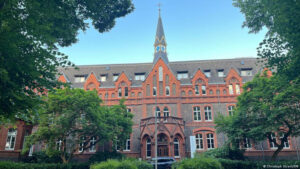 A former Catholic convent now serves as a four-star hotel in Germany
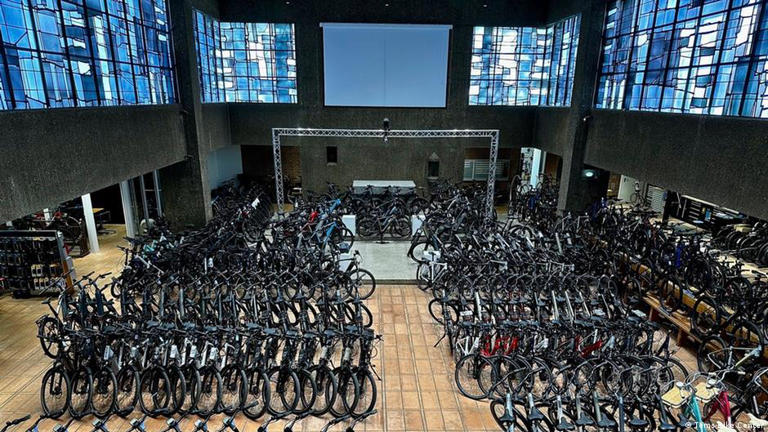
Across Germany, former churches now house bicycle shops, boxing arenas, libraries, pubs, bookstores, daycare centers, and hotels. In Jülich, a former Catholic church has become a bicycle showroom. In Wettringen, an old abbey functions as a “soccer church.” Entire cloisters have been converted into hotel complexes, sometimes retaining their religious names as a nod to their past.
Housing shortages have also driven conversions into residential buildings in cities such as Berlin, Cologne, Trier, Rostock, and Wuppertal. One early example is the Lukas-K-Haus in Essen, where a deconsecrated Protestant church was transformed into apartments while retaining stained-glass windows and historical plaques.
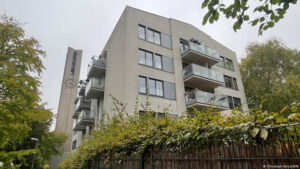 A former church now serves as an apartment block in Germany
Residents often see practicality rather than symbolism. “No one would have thought I’d be living above an altar,” said Alexandra Schröder, who moved into one of the apartments largely because of space and nearby schools.
Below her home, a physiotherapy clinic operates in the former church. Its director, Jessica Günther, says the building’s calm atmosphere suits her work. One patient, Stefan Hebenstreit, views the new use as an extension of Christian values, saying that helping people in need remains central to faith.
Still, not everyone is at ease with the changes. Longtime neighbors miss the sound of bells and regret that church tower clocks have stopped for good.
Church authorities and researchers agree that the fate of former churches is deeply tied to local needs. Art historian Klaus-Martin Bresgott of the Protestant Church in Germany argues that even oversized or unused churches can still serve communities, particularly in neighborhoods lacking public space.
“Times always change,” Bresgott said, noting that churches have served many secular functions throughout history. “We must not immediately panic and say: close down, give up.”
As Germany continues to secularize, the challenge facing communities is no longer whether churches will close, but how these buildings can continue to serve society once faith has moved elsewhere.