 Skip to content


“Nigeria First” policy: NCDMB launches Engineering Olympiad to spur local innovation

The Nigerian Content Development and Monitoring Board (NCDMB) has launched a new national initiative aimed at driving innovation among young engineers and closing the country’s widening skills gap.
In partnership with Renaissance Africa Energy Company Limited and First Exploration & Petroleum Development Company (First E&P), the Board has introduced the Nigerian Engineering Olympiad, a competition designed to push engineering students to develop practical solutions to real industrial and societal problems.

The programme is championed by Enactus Nigeria with the Nigerian Society of Engineers (NSE) serving as a key technical partner.
Announcing the initiative, NCDMB’s General Manager for Corporate Communication, Dr Obinna Ezeobi, said the Olympiad is structured to awaken creativity among engineering students and expose them to the type of problem-solving the nation needs.
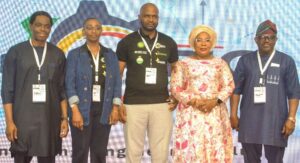 From left: General Manager, Nigeria Content Development, Renaissance Africa Energy Company Limited, Engr. Lanre Olawuyi, General Manager, Integrated Gas at First E&P, Engr. Yetunde Taiwo, Country Director Enactus Nigeria, Michael Ajayi. President, Nigerian Society of Engineers (NSE), Engr. Margaret Aina Ogunsola, and Director Capacity Building, NCDMB, Engr. Abayomi Bamidele at the launch of Nigerian Engineering Olympiad (NEO) in Abuja
The Board’s Executive Secretary, Engr. Felix Omatsola Ogbe, said the project aligns with President Bola Ahmed Tinubu’s “Nigeria First” policy, which calls for stronger local content development across all sectors.
Ogbe noted that Nigeria’s population gives it enormous potential, yet the engineering industry continues to suffer from a shortage of job-ready graduates. He warned that the low preparedness of new engineers fuels a cycle of expatriate dependence, rising brain drain, and a shrinking pool of competent local professionals.
Represented by the Director of Capacity Building, Engr. Abayomi Bamidele, Ogbe said the Olympiad supports the Board’s broader human-capacity investments, which already include training in petroleum engineering, robotics, digital technology, and related fields.
He said the long-term goal is to build an annual national platform that identifies talent early, nurtures it through structured mentorship, and links promising young innovators to commercialization pathways.
Beyond technical ability, he added that the competition is meant to strengthen leadership and entrepreneurial skills so young engineers can either excel in industry or build their own ventures.
The Federal Ministry of Youth Development offered similar backing. Minister Ayodele Olawande, represented by Ms Ebiho Agun, described Nigerian youth as one of the country’s greatest natural advantages in an innovation-driven world.
She said the Olympiad gives students space to stretch their imagination, deepen their technical knowledge, and present their ideas on national and international stages.
Addressing the students as “the heartbeat of Nigeria’s future,” she urged them to treat the Olympiad as a launchpad for growth, learning, and career direction, while reaffirming the Ministry’s ongoing commitment to programmes that encourage creativity and mentorship.
Applications for the competition opened on 20 November 2025 and will close on 11 January 2026. From there, contestants will begin a four-stage journey starting from intra-school contests, moving through regional screenings, and advancing to a semi-final boot camp for prototype refinement.
The top twelve will compete for a place in the national grand finale, scheduled for 11 April 2026, where four winners will be named as the country’s standout innovators.
Explaining the concept, Enactus Nigeria Country Director, Michael Ajayi, said the Olympiad is built on the belief that innovation begins in the minds of young engineers who need both guidance and exposure to turn ideas into impact.
According to him, NEO connects academic creativity with industry realities and provides the bridge that turns knowledge into enterprise. First E&P’s General Manager for Integrated Gas, Engr. Yetunde Taiwo, restated the need for such support, noting that many graduates leave the country not because they want to, but because they have too few opportunities to apply their skills at home.
She said the Olympiad, supported by strong government-industry collaboration, can help keep talent in the country and show young engineers that viable careers exist within Nigeria’s energy sector.
The project also received endorsement from the National Agency for Science and Engineering Infrastructure (NASENI).
Its Executive Vice Chairman, Khalil Suleiman Halilu, represented by Engr. Amino Hamisu, described the Olympiad as a landmark initiative that strengthens engineering excellence and supports long-term technological development.
The President of the Nigerian Society of Engineers, Engr. Margaret Aina Ogunsola, called it a “watershed moment” for linking academia with industry needs.
She said the programme will help transform final-year engineering projects into commercially viable solutions through structured mentorship, prototype development, and intellectual property support, with NSE providing expert oversight to ensure global standards are met.
With the Olympiad now underway, industry leaders say the real test will be how effectively Nigeria can turn student ideas into products, enterprises, and long-term career paths.
For many of the participants, the journey from classroom concept to real-world engineering begins here.



