Skip to content


Passengers in horror as plane plunges 28,000ft in seconds

Terrified passengers texted worried messages to their loved ones as a Virgin Australia flight from Sydney to Brisbane suddenly lost cabin pressure at high altitude and plunged 28,000ft within seconds.
Flight VA993 hit crisis just 40 minutes after taking off at 8.30pm on Thursday as the Boeing 737-800 immediately dropped from its 37,000ft cruising altitude down to under 10,000ft, with pilots sounding emergency calls to air traffic control.

Altitude graphs from Flightradar24 showed the plane’s steep descent from its peak altitude of 37,000 feet.
‘Emergency landing – love you,’ one passenger on the flight, Haley, urgently texted to her husband when the plane began to lose altitude. In a subsequent message she informed him ‘plane’s dropping.’
However, the plane continued safely at the lower altitude – where it doesn’t need to be pressurised – until it landed in Brisbane.
Footage from onboard the aircraft showed oxygen masks hanging from the overhead cabin compartments as flight attendants walked the aisle to calm passengers.
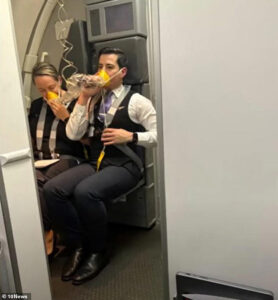
A Virgin Australia spokesman said the flight landed safely in Brisbane despite the ‘depressurization event’.
‘The flight crew took the appropriate steps, following standard operating procedures, to descend to a lower altitude,’ the spokesman said.
‘As part of that process, a PAN call was transmitted to Air Traffic Control.’
An emergency PAN call is a standard call for assistance in an urgent situation. It differs from a Mayday call, which is only issued in a life-threatening situation.
The Virgin spokesman said no passengers or crew members were injured in the incident.
He said the aircraft will be investigated by engineers and the airline will review the situation against their safety standards.
The airline’s guest relations workers have reached out to affected passengers.
When planes experience ‘rapid’ depressurization pilots execute a drop down to a breathable altitude as quickly as possible.
During the descent G-Forces remain around 1G. As the aircraft maintains a steady speed in the dive, vertical acceleration is mostly stable.
In the case of ‘rapid’ depressurization, passengers could experience ear pain, or ‘popping’, temporary loss of hearing and headaches, according to a report by the Australian Transport Safety Bureau (ATSB).
In a previous depressurization event, the ATSB said passengers ‘also reported high levels of anxiety and feelings of panic, with associated physiological symptoms such as a ‘racing heart’.
‘Several passengers reported feelings of faintness, light-headedness and or tremors.
Depressurization can occur within seconds and is associated with the sound of a bang and a ‘fogging’ of the cabin’s air.
Pilots are trained to deal with such an incident, but depressurization can still pose a danger if crew members are incapacitated by a lack of oxygen.