Skip to content

Africa launches $5bn energy bank as global lenders retreat from fossil fuels

The African Export-Import Bank (Afreximbank) and the African Petroleum Producers’ Organisation (APPO) have formally launched the Africa Energy Bank (AEB), a $5 billion pan-African financial institution designed to bridge widening funding gaps in the continent’s petroleum industry as international lenders retreat from fossil fuel financing in favour of renewable energy investments and climate action.
The establishment of the Bank comes at a critical time for Africa’s oil and gas industry, which faces mounting capital requirements for exploration, field development, production infrastructure, pipelines, gas processing and refining, even as traditional sources of long-term financing increasingly constrain their exposure to fossil fuel projects.
The withdrawal of international financial institutions from oil and gas financing, driven largely by global energy transition commitments and climate-related investment policies, has heightened concerns about the availability of capital to develop Africa’s petroleum resources and expand its energy infrastructure.
The challenge is compounded by the changing investment strategies of international oil companies (IOCs), many of which are limiting long-term commitments to capital-intensive petroleum exploration, development and processing projects as they restructure portfolios, prioritise capital discipline and redirect investments towards lower-carbon energy businesses.
Against this backdrop, the Africa Energy Bank is expected to provide an alternative financing platform through which African governments, national oil companies, financial institutions and private investors can mobilise capital for projects considered essential to the continent’s energy security, industrialisation and economic development.
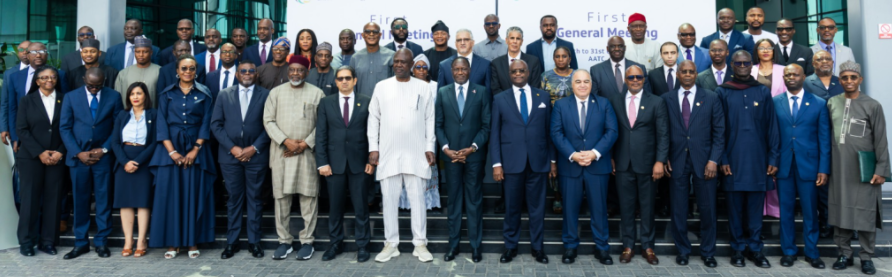
The formal announcement of the Bank was made at its inaugural general meeting in Abuja, Nigeria, where stakeholders reaffirmed the determination of African governments to take greater responsibility for financing the continent’s energy future.
With an authorised capital of $5 billion, the institution is expected to help address Africa’s estimated $200 billion energy investment requirements, particularly the funding constraints confronting petroleum-producing countries seeking to expand production, develop domestic refining capacity and strengthen oil and gas transportation and processing infrastructure.
The financing challenge is particularly significant in the upstream sector, where exploration, appraisal, drilling and field development require substantial upfront investments and long repayment periods. Offshore developments, deepwater projects, marginal fields and frontier exploration activities are especially capital-intensive, making access to affordable long-term financing critical to sustaining investment and growing production.
In the midstream sector, the requirements are equally substantial, with the development of pipelines, gas processing facilities, storage terminals, transportation infrastructure and refineries demanding significant capital commitments. The limited availability of financing has continued to constrain the development of infrastructure required to connect production assets to domestic and regional markets, deepen local value addition and reduce dependence on imported petroleum products.
For Africa, where oil and gas remain important components of national revenues, foreign exchange earnings, industrial feedstock and electricity generation, the retreat of conventional international lenders presents an additional obstacle to exploiting available resources and meeting growing domestic energy demand.
Afreximbank and APPO said the Africa Energy Bank was conceived to bridge this financing gap while supporting a just energy transition that takes account of the different development priorities and energy realities of African countries.
They noted that substantial investments in energy generation and transmission were also necessary to accelerate industrial growth and enable African economies to take advantage of emerging technologies, particularly artificial intelligence (AI), which is expected to increase demand for reliable energy supplies.
The Bank’s mandate covers financing across the entire energy value chain, including exploration and production, transportation, processing, refining and distribution. Its investments are expected to strengthen productive capacity, encourage domestic value addition, reduce reliance on imported petroleum products and promote intra-African trade in energy commodities.
Beyond providing financing, the institution is expected to promote greater African participation in the ownership, development and financing of energy assets, ensuring that the continent’s petroleum resources generate more economic value for its people.
The Bank will operate as an independent, supranational pan-African financial institution, seeking to attract investments from governments, national oil companies, financial institutions and private investors to support energy projects across the continent.
Its establishment also reflects growing recognition among African petroleum-producing countries that reliance on traditional international financing channels may no longer provide the scale and continuity of capital required to develop their energy resources.
At its inaugural general assembly, resolutions were passed for the appointment of Mr Helmy Ghazi as the Bank’s inaugural President and the constitution of its first Board of Directors.
The Board comprises representatives from the public and private sectors, as well as leading policy institutions across the continent.
Afreximbank, one of the founding institutions of the Africa Energy Bank, is a pan-African multilateral financial institution mandated to finance and promote intra-African and extra-African trade.
For more than 30 years, the bank has deployed innovative financing structures to support the transformation of Africa’s trade architecture, accelerate industrialisation and strengthen intra-regional commerce as drivers of economic expansion.
A strong supporter of the African Continental Free Trade Area (AfCFTA), Afreximbank established the Pan-African Payment and Settlement System (PAPSS), which was adopted by the African Union as the payment and settlement platform underpinning implementation of the continental trade agreement.
Working with the AfCFTA Secretariat and the African Union, the bank also established a $10 billion Adjustment Fund to support member countries’ effective participation in the continental trade arrangement.
As of September 2026, Afreximbank’s total assets and contingencies stood at more than $54.1 billion, while its shareholders’ funds amounted to $9 billion.
The institution has investment-grade ratings from China Chengxin International Credit Rating Co. Ltd (AAA), GCR (A), Japan Credit Rating Agency (A-), Moody’s (Baa2) and S&P Global Ratings (BBB+). Its headquarters is in Cairo, Egypt.
APPO, formerly known as the African Petroleum Producers’ Association, was established on January 27, 1987, in Lagos, Nigeria.
Represented at the inaugural general meeting by its Secretary-General, H.E. Farid Ghezali, the intergovernmental organisation was established to strengthen cooperation among African oil-producing countries through the coordination and harmonisation of petroleum policies and the promotion of collaboration and knowledge exchange.
Its activities also focus on facilitating the exchange of experience, technical expertise and best practices among member countries to advance the development of Africa’s petroleum industry.
The partnership between Afreximbank and APPO brings together the continent’s financial resources and the collective interests of its petroleum-producing nations in an institutional framework intended to mobilise African capital, attract investment and sustain funding for an industry facing increasing financing constraints.