Skip to content
Algeria kicks off work at own section of $13bn trans-Saharan gas pipeline project

Algeria has officially kicked off work at its own section of the 4,100 km long Trans-Saharan Gas Pipeline (TSGP) project.
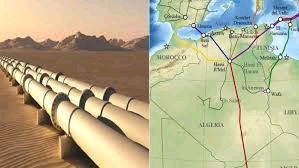
The TSGP is a separate, competing 4, 128km pipeline project running through Niger and Algeria with an estimated cost of about $10 billion to $13 billion.
The TSGP project is running side-by-side with the $25 billion pipeline project being planned by Nigeria, known as the Nigeria-Morocco Gas Pipeline (NMGP) also referred to as the African Atlantic Gas Pipeline).
The announcement came at the close of the fifth ministerial meeting of the project’s steering committee, held in Algiers in the presence of the energy ministers of Algeria, Niger and Nigeria.
According to a statement from Algeria’s hydrocarbons ministry, the Trans-Saharan Gas Pipeline is part of the New Partnership for Africa’s Development (NEPAD).
According to the statement, the three countries involved said the pipeline would strengthen Africa’s role in global energy markets while promoting investment, economic growth and regional integration.
Stretching 4,128 kilometres, the TSGP is estimated to cost around $13 billion and is considered “one of the most strategically important energy projects on the African continent.”
It aims to carry up to 30 billion cubic metres of natural gas per year from Nigeria, through Niger, to Algeria, enabling exports to European and international markets.
The project dates to the early 2000s.
In 2009, Nigeria’s NNPC Ltd, Algeria’s Sonatrach and Niger’s Société nigérienne du pétrole (Sonidep) signed an intergovernmental agreement governing its implementation.
However, after years of stalled progress, the project was revived in July 2022 when the energy ministers of the three countries signed a memorandum of understanding in Abuja to update technical studies and accelerate its completion. Additional agreements were reached in 2025 to update the feasibility study.
The pipeline is expected to deliver significant economic benefits for the three partner countries.
Nigeria holds the continent’s largest natural gas reserves, estimated at 215.10 trillion cubic feet (Tcf) as of January 1, 2026, up from around 210 Tcf a year earlier, according to the Nigerian Upstream Petroleum Regulatory Commission (NUPRC). The pipeline would provide a new export route for its natural gas and boost revenues through improved access to European markets.
Niger is expected to benefit from transit fees, job creation and related infrastructure development.
Algeria, which already has a developed energy industry and exported 49 billion cubic metres of gas in 2024, would strengthen its position as an energy hub linking Africa and Europe, drawing on its existing gas network and export infrastructure.
The steering committee’s ministerial meeting also reviewed progress on the project, including a presentation of findings from a feasibility study conducted by consulting firm Penspen and an assessment of implementation of the roadmap adopted at previous meetings held in Niamey, Abuja and Algiers.