Skip to content

Nigeria unveils 10-year capital market plan, national savings scheme to drive $1tn economy

Nigeria has unveiled a 10-year capital market development roadmap and a national savings plan designed to mobilise domestic resources, attract international investment and strengthen the country’s capacity to finance its ambition of building a $1 trillion economy by 2030.
The masterplan targets domestic and foreign investment, infrastructure financing, SME growth and financial inclusion as the Securities and Exchange Commission (SEC) seeks to deepen market capacity.
The Nigeria Capital Market Masterplan 2.0, covering 2026 to 2036, outlines a series of reforms aimed at creating a more diverse, efficient and transparent financial market capable of channeling long-term capital into businesses, infrastructure and other priority sectors of the economy.
The National Savings Scheme, launched alongside the masterplan, is expected to complement the reforms by encouraging savings and strengthening the pool of domestic funds available for investment and economic development.
The two initiatives reflect a policy emphasis on deepening Nigeria’s domestic capital base while improving the country’s attractiveness to foreign investors and positioning its financial markets as a regional hub for capital formation.
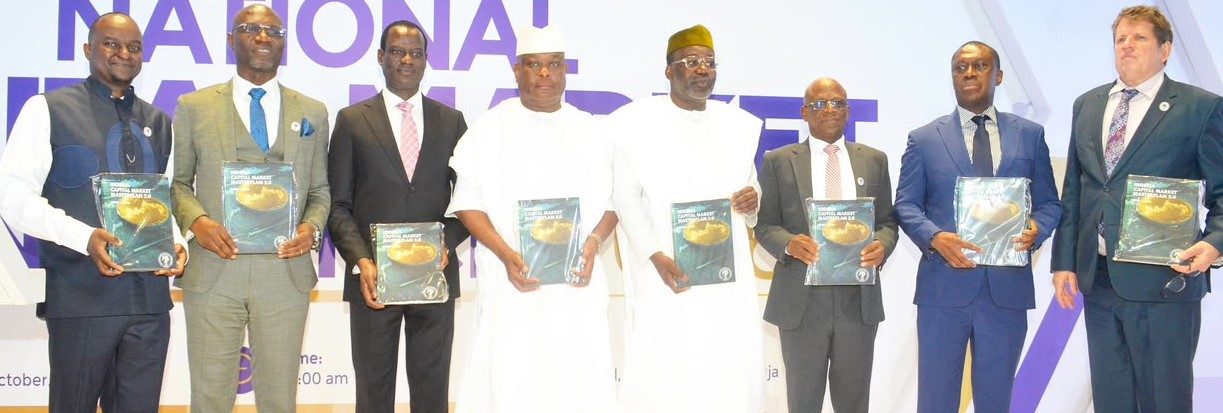
The plans were launched by Vice President Kashim Shettima alongside Taiwo Oyedele, Minister of Finance and Coordinating Minister of the Economy; Peter Vowles, the British High Commissioner to Nigeria; and Mark Napier, Chief Executive Officer of FSD Africa.
The Securities and Exchange Commission (SEC) developed the masterplan with technical support from FSD Africa, funded by the United Kingdom Government. The support enabled a consortium led by Genesis Analytics and Bourse Consult to assist with developing the roadmap and its implementation framework.
Speaking at the launch, Dr. Emomotimi Agama, Director-General of the SEC, described the masterplan as an important step towards building a capital market capable of financing Nigeria’s economic ambitions.
“Every great economy has, at its heart, a capital market that turns the savings of ordinary people into the factories, roads, homes and businesses that create jobs. Nigeria has the people, the enterprise and the ambition. What we are now building is a market to match them,” Agama said.
He said the decision to launch the masterplan alongside the National Savings Scheme reflected the importance of mobilising domestic resources to support national development.
Emphasising the relationship between savings and investment, Agama added: “Savings are the raw material of investment, and a nation that saves through its own capital market builds with its own resources.”
The SEC chief’s remarks highlighted the central objective of the initiatives: expanding the domestic pool of investible funds while creating the market structures and regulatory conditions required to channel those resources into productive economic activities.
For Nigeria, where infrastructure requirements, business financing needs and development priorities compete for limited financial resources, a deeper capital market could provide an additional channel for funding long-term investments beyond traditional bank lending and government revenue.
However, the scale of the expected contribution will depend on the effective implementation of the proposed reforms, the confidence of domestic and foreign investors, and the ability of businesses and public institutions to translate access to capital into productive investments.
The Nigeria Capital Market Masterplan 2.0 seeks to position the capital market as a driver of economic transformation by expanding its capacity to finance infrastructure, energy, climate resilience, small and medium-sized enterprises (SMEs), financial inclusion and job creation.
Its proposed reforms are intended to make it easier for businesses and state governments to raise capital, increase participation by retail and diaspora investors, attract more foreign institutional investment and expand financing options for emerging sectors.
The roadmap also identifies sustainable finance and digital and tokenised assets as areas for market development, reflecting efforts to broaden the range of financial instruments available to investors and issuers.
Under the framework, implementation is organised around five pillars covering regulatory clarity and enforcement, modernisation of market infrastructure, expansion of issuers and financial instruments, diversification of the investor base, and strengthening of institutional and professional capacity.
Each pillar is supported by a sequenced implementation plan specifying responsibilities, timelines and measures of success.
The emphasis on implementation is significant because the new roadmap builds on the experience of an earlier capital market masterplan that achieved an overall activity completion rate of 63 per cent.
While the previous plan supported a number of reforms, financial inclusion, regional integration, sustainable finance and mobilisation of capital into priority sectors remained areas requiring further progress.
The new framework therefore seeks not only to introduce additional reforms but also to address outstanding gaps in the development of the market.
Its success will depend on whether the proposed measures are translated into effective regulatory changes, more accessible investment products, stronger market infrastructure and greater participation by businesses and investors.
The United Kingdom Government has described the masterplan as a Nigerian-led reform initiative designed to mobilise more domestic and international investment and connect available capital with commercial opportunities in businesses and infrastructure.
In a statement delivered on behalf of British High Commissioner Peter Vowles, Paul Healey, Head of Green Growth and Private Sector Development at the British High Commission, said the UK was proud to have funded FSD Africa’s support for the development of the roadmap.
“The UK is proud to have funded FSD Africa’s support for the development of Nigeria’s Capital Markets Masterplan 2.0. This ambitious, Nigerian-led reform will help mobilise more domestic and international investment and connect capital with commercial opportunities in businesses and infrastructure,” he said.
Healey said the initiative formed part of the broader UK-Nigeria Strategic Partnership, which places economic growth and employment creation among its priorities.
“Our support forms part of the wider UK and Nigeria’s Strategic Partnership, which has growth and jobs at its heart. By strengthening Nigeria’s capital markets and deepening links between our financial sectors, we can create new opportunities for investment, jobs and shared prosperity in both our countries,” he added.
The UK’s support reflects the role of development partnerships in strengthening the institutions and market structures needed to mobilise long-term financing.
For Nigeria, stronger links with international financial markets could broaden access to investment capital, improve opportunities for cross-border transactions and help businesses connect with investors seeking viable commercial opportunities.
Such benefits, however, will depend on the country’s ability to maintain predictable regulatory arrangements, protect investors and demonstrate that investment opportunities offer credible prospects for returns.
Mark Napier, Chief Executive Officer of FSD Africa, said the masterplan was grounded in the principle that capital markets should serve the wider economy by directing finance towards businesses, infrastructure and sustainable growth.
“Our support for Nigeria’s new Masterplan is grounded in the principle that capital markets need to work for the wider economy. With its scale and regional importance, Nigeria has a significant opportunity to mobilise more domestic and international capital towards businesses, infrastructure and sustainable growth,” Napier said.
He pointed to experiences in Zambia and Ethiopia, where FSD Africa had supported efforts to strengthen financial market structures and address regulatory and market constraints.
“We have seen how sustained capital market development can help create conditions for greater capital mobilisation. In Zambia and Ethiopia, our support to strengthen the country’s financial market architecture and address key regulatory and market constraints, helped lay the foundations for greater capital mobilisation, including into sectors such as renewable energy,” he added.
The examples underline the importance of building the institutional foundations that allow financial markets to channel capital towards productive investments.
For Nigeria, the challenge extends beyond attracting funds. It also involves developing reliable mechanisms through which businesses, infrastructure projects and public institutions can access long-term financing on viable terms.
A more developed capital market could give companies alternatives to conventional bank loans, enable governments to explore appropriate market-based funding options and create investment opportunities for individuals and institutions.
It could also help direct capital towards sectors requiring substantial upfront investment, including electricity, energy infrastructure, transport, housing and climate-related projects.
The launch of the National Savings Scheme alongside the masterplan places domestic savings at the centre of the country’s capital mobilisation strategy.
The underlying objective is to strengthen the connection between household and institutional savings and productive investment, creating a larger domestic pool of funds that can support economic expansion.
A stronger domestic savings base could help reduce exclusive dependence on foreign capital and provide a more sustainable source of financing for businesses and long-term projects.
It could also broaden participation in the financial system by encouraging more Nigerians to engage with formal savings and investment channels.
However, the extent to which the initiative can achieve these objectives will depend on the scheme’s design, the attractiveness of its savings and investment options, public confidence in financial institutions and the ability of households to set aside money amid competing consumption needs.
The relationship between savings and investment is particularly important in an economy seeking rapid expansion. While savings can provide funds for investment, effective financial intermediation is needed to ensure those resources reach productive businesses and projects.
This makes investor protection, transparency, accessible financial products and confidence in market institutions essential to the success of the wider programme.
The SEC’s regulatory role will therefore remain central to ensuring that the expansion of market participation is accompanied by appropriate safeguards against misconduct and systemic risks.
Beyond domestic investment, the masterplan seeks to strengthen Nigeria’s position in African financial markets through closer cooperation with other countries, cross-border capital raising and listing frameworks, and greater alignment with initiatives under the African Continental Free Trade Area (AfCFTA).
The ambition is to improve the ability of businesses and investors to access opportunities across African markets while supporting Nigeria’s emergence as a regional centre for financial transactions.
Greater integration could expand the range of potential investors available to Nigerian companies, improve opportunities for cross-border investment and encourage the development of financial products serving businesses operating in multiple African countries.
The proposed development of digital and tokenised assets also points to an effort to broaden the instruments through which capital can be raised and traded.
Such innovations could create new opportunities for investment and improve market accessibility, but their development will require clear regulatory rules, appropriate technological infrastructure and effective investor safeguards.
For the SEC, the challenge will be to support innovation while maintaining the fairness, transparency and stability required for a credible capital market.
The masterplan’s emphasis on regulatory clarity and enforcement, modern market infrastructure and professional capacity is intended to address some of these requirements.
The SEC, Nigeria’s apex capital market regulator, derives its mandate from the Investment and Securities Act 2025. Its responsibilities include developing and regulating the capital market to promote capital formation, protect investors, maintain fair, efficient and transparent markets, and reduce systemic risks in support of national economic development.
The new masterplan places these responsibilities within a longer-term framework for expanding the market’s contribution to the economy.
Its priorities are particularly relevant to Nigeria’s ambition of building a $1 trillion economy by 2030, a target that requires sustained expansion of productive capacity, investment and business activity.
A deeper capital market could help mobilise financing for the infrastructure and enterprises required to support that expansion. It could also give investors more opportunities to participate in economic growth while enabling businesses to access funding suited to their investment horizons.
Nevertheless, the launch of a roadmap does not in itself guarantee that the anticipated capital will materialise or that investment will translate into economic growth and jobs.
The ultimate test will be the extent to which the proposed reforms improve access to finance, broaden the investor base, strengthen confidence in market institutions and increase the flow of capital into productive sectors.
For the National Savings Scheme, a critical measure will be whether it can encourage sustainable savings and connect those resources to credible investment opportunities. For the capital market masterplan, the measure will be whether its five pillars produce tangible improvements in market depth, transparency, accessibility and financing capacity.
FSD Africa, a specialist development agency working with governments, regulators and financial institutions across 30 countries, supports initiatives to strengthen financial markets and mobilise capital for economic growth, climate resilience, clean energy and nature-positive development. Through its investment arm, FSD Africa Investments, it also deploys catalytic capital to support development objectives.
Its partnership with the SEC on the masterplan reflects an approach that combines regulatory development, market reform and investment mobilisation to address financing constraints.
Ultimately, Nigeria’s ability to realise the economic benefits of the two initiatives will depend on consistent implementation, public confidence and the capacity of financial institutions to connect savings with viable investments.
The 2026–2036 roadmap provides a framework for that effort. Its significance will be determined by whether it can help transform domestic savings and international investment interest into the businesses, infrastructure, employment and productive capacity needed to sustain Nigeria’s long-term economic ambitions.