Skip to content


Receivership: Ikeja Electric launches aggressive revenue drive

Sopuruchi Onwuka
The field officers and corporate executives of the Ikeja Electricity Distribution Company, popularly called Ikeja Electric, are currently on rampage to compel non-performing customers to turn up with payments.

Expectedly the aggressive debt recovery effort propelled by pressure from lender, FBNQuest, is intensive on non-metered and poorly serviced residential areas of Lagos where billing disputes and poor collection processes leave consumer accounts with mounting debts.
Oracle Intelligence reports that FBNQuest has been locked in legal combat with the management of Sahara Group over attempts by the lender to take over Ikeja Electric, Egbin Power, First Independent Power and other sister affiliates including KEPCO Energy Resources.
The companies targeted in the takeover bid form main subsidiaries of the Sahara Energy group which plays prominently in the governments intricate gas-to-power programme. Under the programme, government had bonded strange commercial bedfellows in a string of commercial operations whose fate depends on the efficiency and profitability of electricity distribution companies popularly called DISCOS.
While most of the Sahara companies in the gas-to-power programme hold bad debt record with FBNQuest, Ikeja Electric which plays in the market end of the commercial relay appears to take more hit for failing to generate adequate revenue to help itself and help salvage sister companies in the upstream end of the investment loop.
Oracle Intelligence reports that some five other DISCOs including Benin Disco, Port Harcourt Disco, Kaduna Disco, Ibadan Disco and Abuja Disco had earlier slipped into receivership of lenders.
The Nigerian Electricity Regulatory Commission (NERC) had also threatened most of the DISCOs, including Ikeja Electric, with aggressive takeover if they failed to inject appreciable capital to improve their operations.
Since the controversy over the appointment of receivers for the Sahara companies, all hands in the corporate headquarters of the parent company have been on deck, pulling all possible strings to stave off looming forfeiture of management control of the companies.
And within days of the receivership announcement, the Federal Executive Council (FEC) rapidly approved payment of over N4 trillion to address liquidity squeeze in the gas-to-power programme, a fundamental quandary related to the highly criticized bill estimation method and the consequent customer refusal to pay unconvincing bills.
Although Ikeja DISCO is structured to make revenue remittances to the Nigerian Bulk Electricity Trading Company (NBET), the payment minus transmission and invoicing tariffs is expected to ultimately pass onto sister Egbin Power Generation Company which is in turn committed to paying its fuel suppliers for natural gas or fuel oil. Thus, it is generally believed that the sister Sahara companies have failed to harness internal chain economics despite being closely aligned in the gas-to-power programme.
However, with lenders breathing host on its neck, the Ikeja Electric launched off tough offensive on unmetered customers across its network; supported by high level executive management supervision from the Sahara Group.
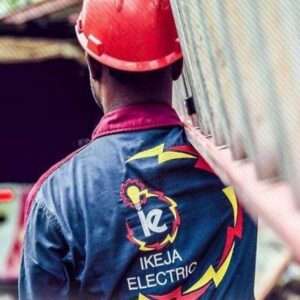
Reporters who monitored the ongoing exercise also noted that the drive comes along with improved supply of electricity only at nights in most of the residential areas, with the Alimosho council area welcoming troops of ladder carrying linesmen and corporate executive parading printout of addresses with hefty debts.
“The process is to encourage those struggling to pay their bills while disconnecting those with history of non-payment,” one of the executives who is said to be an accountant from the corporate headquarters of the company explained to community development association leaders in Alimosho area.
He stated that the Ikeja Electric is bearing increasing responsibility for the worsening fortunes of the parent Sahara Group as the receivership battle with lenders persists.
Nigerian Electricity Regulatory Commission (NERC) which set a January recapitalization deadline for the DISCOs in the country blames them for rising aggregate technical, commercial and collection (ATC&C) losses in the gas-to-power programme. NERC has regularly pointed out that billing disputes and associated collection losses would ease off if the DISCOs met over 80 percent metering coverage of their distribution networks.
Repeated deadlines by the central regulatory authority in the power sector on DISCOs to roll out meters to customers have never been met by any traditional DISCO as most of them point at huge capital requirement for meter acquisition and deployment across their customer range. Different partnership arrangements in providing meters in the distribution networks of the DISCOs have also failed.
However, the young Aba Distribution Company operated by Geomteric Power Limited has been rolling out free meters to customers in its network.
Chairman of the company, Prof Barth Nnaji, told Oracle Intelligence that the company invested in free metering programme to improve billing transparency and enhance commercial and revenue collection efficiency.
One of the CDA executives in Akowonjo area of Lagos, Mr Waheed Animashaun, told our correspondents that monitored the revenue drive in the area that the only way for the Ikeja Electric to achieve steady flow of revenue with little operational expenses is by full metering coverage.
He stated that the DISCOs would never get efficient with customer service and revenue generation as long as government continues to inject free money into the system.
A former Managing Director of one of the DISCOs in Lagos told our correspondent that the main reason for delaying metering coverage is enhanced revenue generation from unmetered customers, revealing that the companies lose commercial manipulation of customers after injecting prepaid and smart meters.
“Prepaid smart meters mean that you don’t pay when there is no light; and customers can control or manage their consumption to cut down on cost. But with estimation, you are guaranteed steady income from a particular area,” he explained.
He however regretted that bill estimation saddles the poor and the voiceless with heavier consumption cost than prepaid meters task privileged customers in high brow residential areas.
He however emphasized that commercial and industrial customers form the main revenue base for every DISCO.