Skip to content


LNG capacity race projects 748 mtpa by 2030, triggers supply chain bustle

- NLNG Train-7,Mozambique LNG lead Africa’s capacity growth
- US emerges global oil and gas export champion
Sopuruchi Onwuka
Total global liquefied natural gas (LNG) capacity will hit significant 748 million tons per annum (mtpa) by 2030, driven by significant 253.6 mtpa of total global liquefaction projects that scaled final investment decisions and under construction stages.
The race in the LNG capacity development, it was noted, expectedly propels proportionate import handing capacity development which topped 70 mtpa to 2023 levels to reach 1,029.9 mtpa in 2024.
The copious spread of liquefaction projects also indicates the regional race for liquefaction capacity growth and the rising influence of the United States as leading supplier of gas for mainly industrial and power generation. The US is also the world’s leading crude oil exporter.
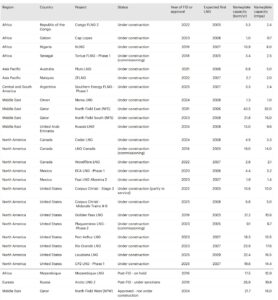
And whereas the Mozambique LNG leads Africa’s new capacity with post-FID proposition for 12.9 mtpa, the project remains on hold. And the Nigeria LNG Limited’s (NLNG’s) remains the effective capacity growth driver in the continent with its 8.0 mtpa Train 7 project which is currently under construction in Bonny Island, Rivers State.
Global LNG project data available to Oracle Intelligence shows that although both companies reached FID in 2019, the Mozambique LNG is yet to reach advanced project stages with the new capacity which would require significant 17.5 bcm/y of gas supply.
Other projects that make up the new 26.5 mtpa new capacity emerging from African include Congo’s FLNG 2 project with 2.4 mtpa; Gabon’s Cap Lopez project with 0.7 mtpa; and Tortue FLNG – Phase 1 project with 2.5 mtpa.
Total feedstock requirement for all Africa’s new LNG projects currently under construction amount to 36.1 Bcm/y.
But total capacity addition from Africa is just a small fraction of the total of 99.3 mtpa emerging from the United States alone. And from the Middle East, Qatar projects new capacity of significant 57.6 mtpa from a number of projects currently under construction. Russia’s 19.8 mtpa Arctic LNG 2 which also reached FID in 2019 could not progress to project stages due to sanctions.
Review of trends in the global energy demand patterns by Oracle Intelligence shows that global LNG liquefaction capacity grew by 6.5 mtpa in 2024 to a total of 494.4 mtpa; following the acceptability of natural gas the cleanest form of available fossil energy.
According to the International Energy Agency (IEA), the world currently has about 670 billion cubic metres (bcm) per year of LNG liquefaction capacity and a total of nearly 295 bcm/yr of new LNG export capacity is expected to come online between 2025 and 2030 from projects that have already reached FID or are under construction, marking the largest wave of capacity additions to date.
Research and Markets reported earlier that global LNG projects are set for growth from 2025-2030, driven by rising natural gas demand, carbon neutrality goals, and geopolitical factors. With 301 projects expected, 177 focus on regasification and 124 on liquefaction.
The pace and scale of this buildout, the agency however noted, could shift due to construction delays, new project FIDs, progress on already approved but currently inactive developments, and other uncertainties.
In a separate forecast, J.P. Morgan Research estimated global LNG supply capacity to increase by ~350 Bcm or ~54% from 2024 levels by 2030, driven primarily by an increase in liquefaction capacity from North America and Qatar.
That supply growth, the advisory firm stated, would also spur a ~300 Bcm increase in regassification capacity globally by 2030. It added that the capacity growth projections form key signal that natural gas will remain an important part of the energy transition.
Leading the global surge in LNG capacity is the United States which is also holds the title of world’s leading exporter of crude oil, pushing back Saudi Arabia, Russia and Iran.
J.P. Morgan Research estimates that the U.S. would produce more than a third of global LNG supply by 2030.
Head of North American Corporate Credit Research at J.P. Morgan, Tarek Hamid, said: “The country has gone from effectively producing zero LNG in 2015 to 86 million tons in 2023, with more projects in various stages of construction underway.”
The capacity race, our review of reports emerging from energy capitals has shown, plausibly spurred a flurry of activities in the global energy industry supply chain with strings of jobs for equipment manufacturers, technology providers and infrastructure developers across the world.
World’s leading shipbuilder, Samsung Heavy Industries, declared Tuesday that it secured fresh orders for seven LNG carriers, nine shuttle tankers, two ethane carriers, four crude oil tankers, two container ships, and one offshore production facility.
The company stated that it aims to secure one more floating liquefied natural gas (FLNG) facility by the end of the year to achieve its target. And industry pundits anticipate that SHI will secure part of the Mozambique FLNG project. The company is also accelerating its final negotiations for an FLNG construction contract with Norway.
The SHI said the order for six LNG carriers would contribute to its efforts to achieve its annual order target of $9.8 billion, breaking its recent drought in orders.
The company stated that the new orders for LNG carriers that would be delivered sequentially by November 2028 are driven in part by demand for eco-friendly vessels.
“The demand for eco-friendly vessels is expected to remain steady following the International Maritime Organization (IMO)’s decision to introduce a global shipping carbon tax,” a representative of the company stated.
So far in 2025, gas related marine facilities account for significant jobs for global ship builders; and SHI said it secured “orders for 7 LNG carriers, 9 shuttle tankers, 2 ethane carriers, 4 crude oil tankers, 2 container ships, and 1 offshore production facility (pre-work).”
Apart from liquefied gas transportation vessels, marine facility builders are also saddled with production of offshore processing facilities as more companies and producing countries drive quick-to-market floating liquefaction projects at offshore production fields.
According to Rystad Energy, the annual production capacity of global FLNG is expected to triple from the current 14.1 MTPA to 42 MTPA by 2030. And for shipbuilders, FLNG is advantageous for improving profitability.
Beyond marine facilities for gas processing and transportation, the race for liquefaction capacity is also propelling pipeline infrastructure capacity development notably in the United States which has been predicted to consolidate its lead in the global LNG supply.
An article by US based journal, Helter Skelter, has it that a wave of LNG FIDs spur a flood of gas pipelines projects and related natural-gas-related infrastructure development in Texas and Louisiana.
The journal reported that developers in the United States advance a slew of inter- and intrastate pipeline projects aimed at bringing Permian, Haynesville and other gas to where it will be needed; saying that “it’s admittedly hard to keep track of it all.
“The Shale Revolution, the world’s push toward lower-carbon sources of energy and Russia’s war on Ukraine, among other things, have combined to make fast-rising U.S. LNG exports a global necessity,” the report pointed out.
The journal stated that the incremental gas demand from new LNG export capacity and new data centers in Texas and Louisiana will be met primarily from rising gas production in the Permian and an expected resurgence in the Haynesville, requiring new pipeline capacity.
The lean towards gas consumption, Oracle Intelligence reports, solidifies the resilience of petroleum fuels in the face of global movement for climate action and the push to migrate energy choices from fossil fuels.
Whereas there is a strong push for energy transition from fossil fuels, the greener and renewable energy options including solar, wind, geothermal and hydrogen fuels are still new, costly and yet to develop capacity for address rapidly growing global energy demand.
And with natural gas now into the basket of acceptable clean energy, clean energy funding and investments have continued to propel projects across the world for robust production of natural as well as its liquefaction and shipment to demand centers.